
Have you ever wondered why counterfeit luxury brands like Gucci are flooding the market? It is estimated that the global counterfeit market has reached a value of $1.7 trillion, accounting for about 3.3% of global trade. So, how can you spot an authentic Gucci label to avoid buying a fake? Find the details below.
How to recognize an authentic Gucci label?
In 2024, American detectives uncovered a network of counterfeiters selling fake handbags Gucci on popular auction platforms, deceiving thousands of customers. Product authenticity is becoming crucial, especially in the era of online shopping, where the risk of encountering counterfeits is high.
In this article, you’ll learn how to identify an authentic Gucci label by paying attention to:
- Material: The quality and texture of the fabrics used.
- Typography: The font and arrangement of letters on the label.
- Security technologies: Elements such as holograms or QR codes.
Knowing these details will help you avoid counterfeits and enjoy authentic Gucci products.
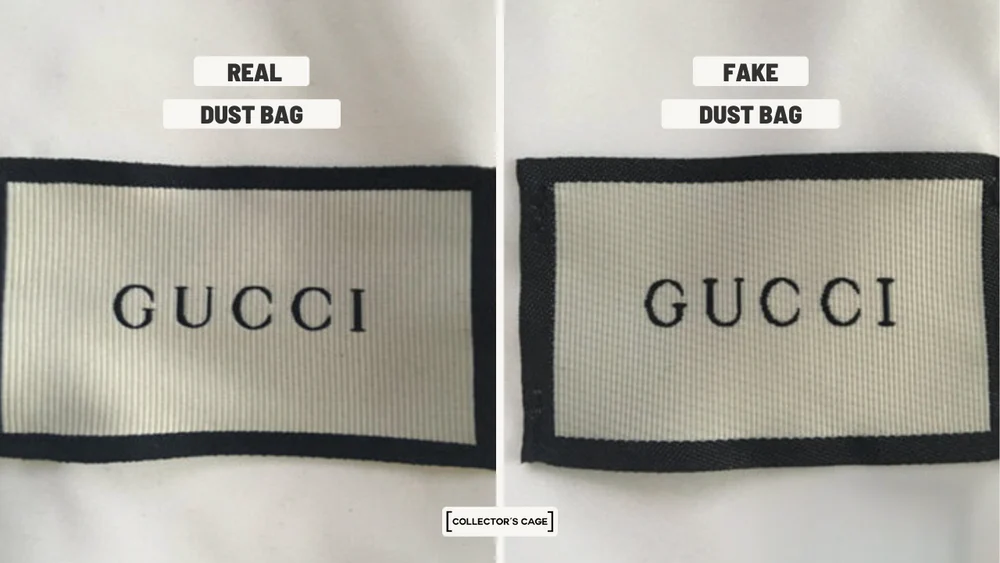
Anatomy of an original Gucci label
Identifying the original Gucci label is crucial for confirming the authenticity of the product. This label contains essential information such as material, typography, serial number, and modern security technologies.
Material and finish
Original Gucci tags are made from high-quality leather, often in a color matching the interior of the bag. For example, in the Soho Disco model, the tag is leather, with precisely finished edges and meticulous stitching. The tag is attached only along the top edge, allowing it to be lifted to check the serial number on the reverse side.
Logo typography
The Gucci logo on the label features a distinctive typography:
- The letter “G”: It has a rounded shape, with ends forming an almost complete circle.
- The letter “U”: Shows asymmetry – the left side is thicker, while the right side is thinner.
- The letters “C”: They are rounded and resemble the shape of the letter “G”.
The entire logo is centered on the label, with the phrase “made in italy” in lowercase letters below.
Serial number and uniqueness
On the back of the label, you’ll find a serial number consisting of two rows of digits (usually 10-13 characters). The first row is the model number, while the second is the supplier or production batch code. It’s important to note that serial numbers are not unique to each bag; identical models may share the same numbers.

Modern features: QR codes and RFID
In newer models, Gucci has introduced additional security features such as QR codes and NFC tags. The QR codes are located on a black fabric label inside the bag and are encrypted, meaning they can only be scanned using the official Gucci app. NFC tags allow for quick authentication of the product by simply bringing a smartphone close to the label.
- Label material: Is the label made of high-quality leather?
- Label stitching: Is the label attached only along the top edge?
- Gucci logo: Do the letters “G” and “U” have distinctive shapes?
- Serial number: Are there two rows of numbers on the back of the label?
- QR/NFC codes: Does the bag feature modern security measures such as a QR code or NFC tag?
- Quality of workmanship: Are all components crafted with care and precision?
Remember, carefully checking these features will help confirm the authenticity of your Gucci product.
Most common counterfeit red flags
Purchasing original Gucci products can be challenging, especially with the abundance of counterfeits on the market. To protect yourself from fraud, it’s worth paying attention to a few distinctive features that may indicate a Gucci tag is not authentic.
- Spelling mistakes and typos
- Original tags from are known for their precise craftsmanship and flawless print. Counterfeits often feature typos or spelling mistakes, such as “Guci” instead of “Gucci.” Even minor inconsistencies in the font or spacing between letters can indicate a fake product.
- Uneven seams and protruding threads
- Gucci is renowned for its exceptional craftsmanship, including even and meticulously finished stitching. Counterfeit items often feature uneven stitches and loose threads. To accurately assess the quality of the stitching, it’s worth using a magnifying glass, which will help reveal any imperfections.
- Duplicate or missing serial numbers
- Every authentic Gucci bag features a unique serial number, usually consisting of two rows of digits. On counterfeits, serial numbers may be repeated, missing, or contain letters, which is inconsistent with Gucci’s practices. It’s important to check whether the serial number is clearly embossed and matches the bag model.
- Poor material quality
- Gucci uses high-quality materials, such as soft and supple leather. Counterfeits are often made from cheaper materials that may feel stiff, have an unpleasant odor, or an uneven texture. When touching the material, pay attention to its texture and flexibility.
- Unconventional label placement
- In authentic Gucci products, the inner label is usually sewn onto the back wall of the bag, just below the top seam or under the pocket, with only the top edge attached. This allows you to lift the label and check the serial number. If the label is in an unusual location or is sewn down on all sides, it may be a sign of a counterfeit.
Authentication expert advises: “Always carefully check details such as the quality of the stitching, the font on the label, and where it is sewn. Even minor deviations from the standard can indicate a counterfeit.”
If you have any doubts about the authenticity of a product, consult an authentication expert or use the services of professional companies specializing in luxury goods verification. Remember, investing in an original product guarantees quality and durability.
Digital technologies and the future of verification
In an era of increasing counterfeits in the luxury goods market, brands like Gucci are implementing cutting-edge technologies to guarantee the authenticity of their products. Traditional methods, such as paper certificates, are being replaced by digital solutions that offer greater transparency and security.
QR codes in the latest collections
Gucci has introduced QR codes to its latest collections, allowing customers to quickly and easily verify the authenticity of products. By scanning the code with the official Gucci app, users gain access to detailed information about the item, including its origin and specifications. This method increases customer trust and makes it more difficult for counterfeiters to operate.
Blockchain for supply chain tracking
Blockchain technology enables immutable and transparent recording of every stage in the production and distribution of a product. This allows both the brand and customers to track the product’s history from its creation all the way to sale. Authorized parties have access to this information, ensuring data privacy and security. An example is the Aura Blockchain Consortium, founded by LVMH, Prada Group, and Cartier, which offers a platform for verifying the authenticity of luxury products.
AI-powered image recognition
Artificial intelligence (AI) plays a key role in identifying counterfeits by analyzing the visual features of products, such as stitching patterns and materials. AI-based systems achieve over 99% accuracy in detecting fake goods, surpassing human experts.
Technology limitations
Despite technological advancements, there are still certain limitations. For example, if a QR code is cloned, it can lead to fraud. Additionally, implementing these technologies involves costs and requires appropriate infrastructure.
Technology comparison
Technology Advantages Risks QR codes Fast verification, ease of use Possibility of code cloning Blockchain Data immutability, full transparency High implementation costs AI High effectiveness in counterfeit detection Requires large datasets for training “The integration of blockchain and AI technologies in the authentication process of luxury products is the future of the industry, providing customers with an unprecedented level of trust.”
The introduction of digital tools for product authenticity verification, such as QR codes, blockchain, and AI, is significantly raising security standards in the luxury industry. Despite certain challenges, the benefits of their implementation outweigh potential risks, offering customers confidence in the originality of the products they purchase.
Leaving the store with confidence in authenticity
In the world of luxury fashion, where authenticity is key, knowing how to verify products like Gucci tags is essential. Understanding the materials, numbering, and technologies used allows you to shop with confidence and avoid counterfeits.
Summary of key lessons
- Material: Original Gucci products are distinguished by top-quality materials and meticulous craftsmanship.
- Numbering: Unique serial numbers are engraved with precision and in accordance with the brand’s internal standards.
- Technology: Gucci implements cutting-edge technologies such as NFC chips and QR codes, allowing for quick verification of product authenticity.
Pre-purchase checklist
To ensure the authenticity of a Gucci product, it’s worth following this 5-step procedure:
- Check the material quality: Make sure the materials are high quality and the craftsmanship is precise.
- Verify the serial number: Compare the serial number with the official patterns available on the Gucci website.
- Take advantage of verification technologies: Use the Gucci mobile app to scan QR codes or NFC chips.
- Shop at authorized retailers: Purchase products only at official Gucci stores or from certified sellers.
- Consult with experts: If in doubt, use the services of professional companies specializing in authenticity verification.
The “shop consciously” principle
We encourage you to shop from authorized sources, which guarantees product authenticity and supports ethical business practices. Remember that purchasing counterfeits not only harms the brand but may also support illegal activities.

Looking to the future
The luxury industry is increasingly turning to artificial intelligence (AI) and decentralized blockchain-based certificates to combat counterfeiting. For example, the fashion house Patou has introduced the Authentique Verify system, which uses AI to verify product authenticity by analyzing microscopic details. Additionally, the Aura consortium, which brings together brands such as LVMH, Prada, and Cartier, uses blockchain technology to create digital certificates for each product, ensuring its authenticity and complete transparency of origin.
By combining traditional expertise with modern technology, you can shop with confidence and enjoy genuine luxury.
A, here you can learn more about men’s fashion according to Gucci