
Table of Contents
- A laser pulse of beauty – why modern lasers are transforming facial care
- Micro-explosions of light within the skin – the anatomy of laser action
- From Ruby to AI – The Evolution of Laser Technologies
- Trends 2025 – picoseconds, hybrids, and intelligent systems
- Safety under scrutiny – protocols, risks, and regulations
- Profit and cost balance – market, statistics, and patient satisfaction
- Heated debates – doctors’ monopoly, ecology, and the ethics of lasers
- Towards radiant skin – next steps and a look into the future
The global cosmetic laser market will exceed $3.2 billion as early as 2025 —a figure that speaks for itself. But behind these numbers lies something far more important than statistics.
Laser pulse of beauty – why modern lasers are transforming facial care
Imagine waking up in the morning and looking in the mirror without that daily sigh. Skin that’s smooth, radiant, and doesn’t need layer after layer of concealer. Sounds like a dream? Maybe not as much as you think.
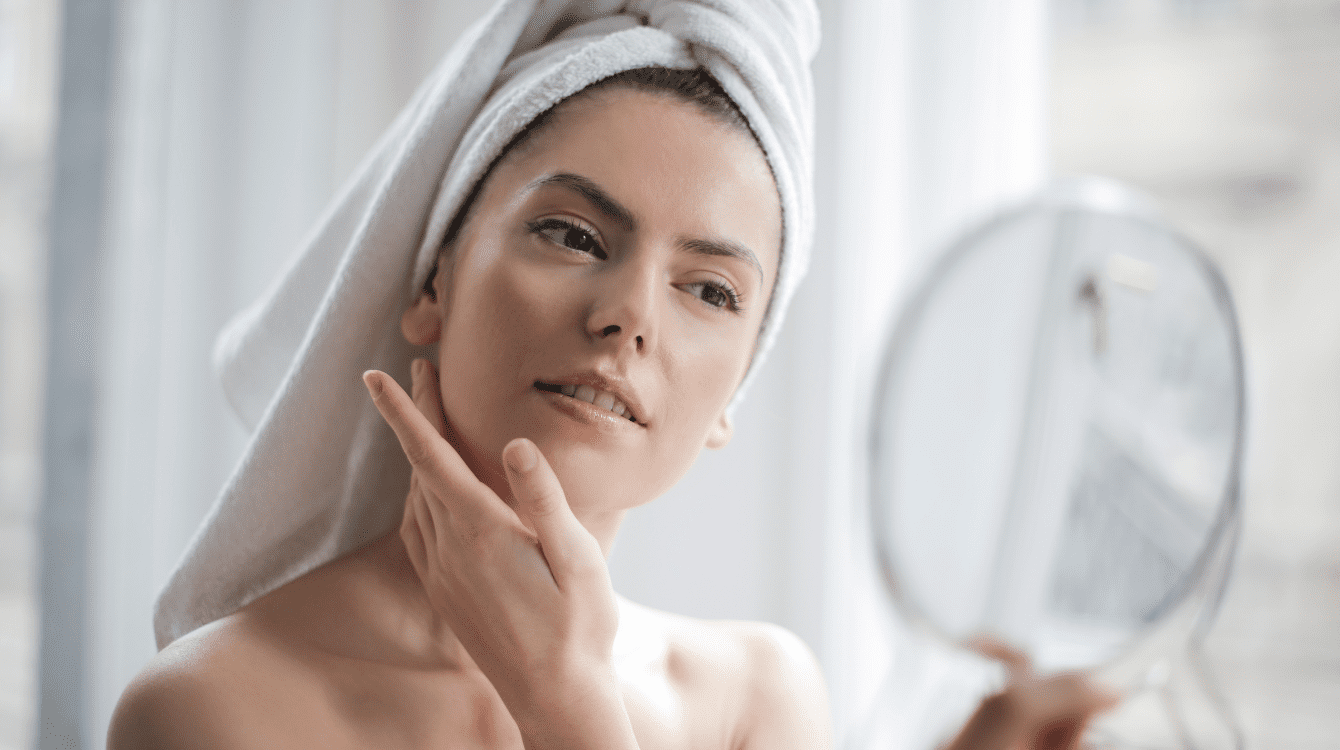
The truth is, our skin ages every single day. Sun exposure, stress, genetics—all leave their mark. In the past, the only options were invasive surgical procedures or simply accepting what we saw in the mirror. Today, there’s a third way.
Modern lasers offer us something we could once only dream of. First, they stimulate the skin’s natural regeneration at the cellular level. Your skin renews itself, but far more effectively. Second, they correct specific imperfections—discoloration, scars, enlarged pores—with a precision no cream can match. Third, thanks to artificial intelligence technology, every treatment can be tailored to your skin’s unique needs.
But a word of caution—not all lasers are created equal. Some promise miracles, while others can do harm if you end up in the wrong hands.
In the following sections, you’ll learn exactly how lasers work on your skin, what types of treatments are available, and—most importantly—how to choose the right therapy and avoid unnecessary risks. Because beauty isn’t just about results, but above all, about safety.
Let’s start with the basics—how do these devices actually affect our skin?
Micro-explosions of light in the skin – the anatomy of laser action
Selective photothermolysis is the fundamental principle behind the operation of cosmetic lasers. It may sound complex, but the mechanism is actually quite simple—the laser emits light at a specific wavelength, which is selectively absorbed by particular structures in the skin known as chromophores.
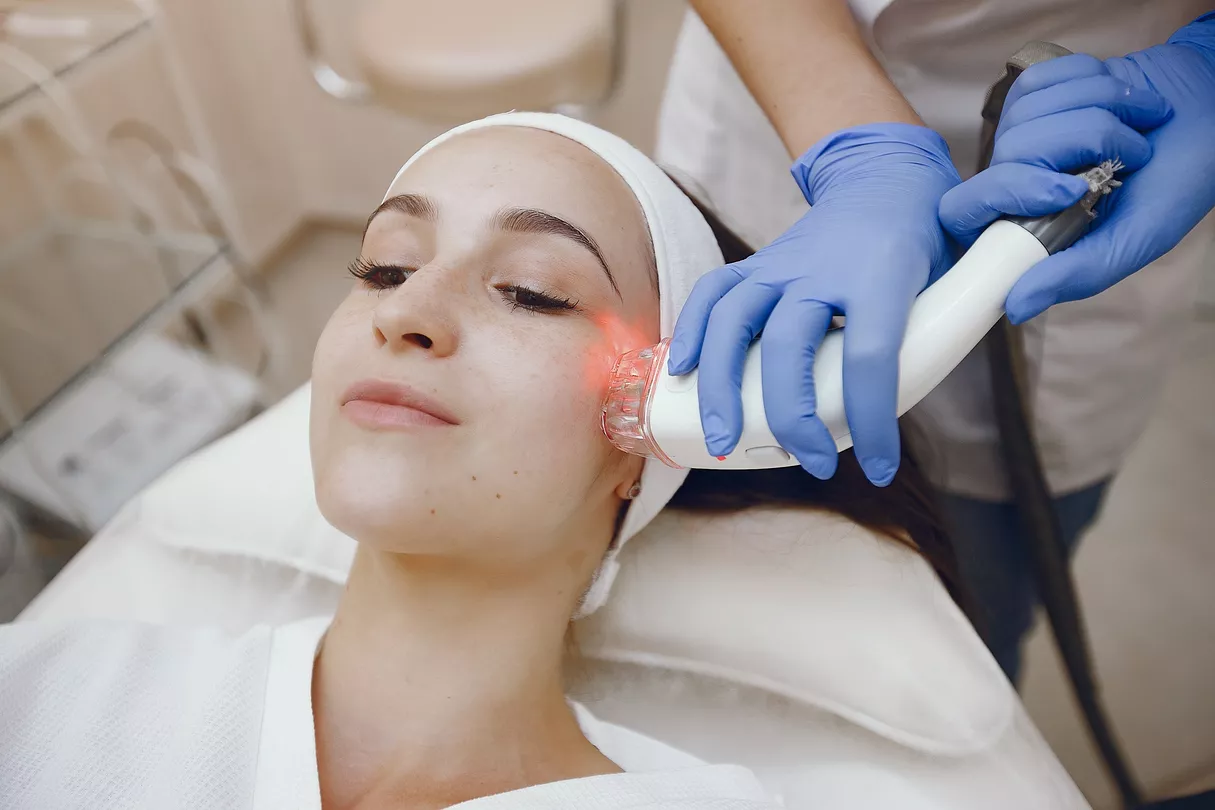
The main chromophores in the skin are melanin (responsible for pigmentation), water, and hemoglobin. Each of them absorbs light most efficiently at different wavelengths. Melanin absorbs light best in the 694-755 nm range, hemoglobin prefers 532-595 nm, and water absorbs wavelengths above 1000 nm. That’s why a dermatologist selects a specific type of laser depending on the desired outcome.
The conversion of photon energy into heat occurs in several stages. First, photons of a specific wavelength reach the chromophore and are absorbed by it. In the case of a picosecond pulse lasting less than one nanosecond, light energy is instantly converted into heat. The local temperature rises to 60-100°C, causing protein denaturation and controlled microdamage within the tissue. This process takes only fractions of a second, but its effects are long-lasting.
The difference between ablative and non-ablative lasers lies in how they interact with the skin’s surface:
| Ablative laser (CO₂) | Non-ablative laser (Nd:YAG) |
|---|---|
| Removes layers of the epidermis | Leaves the epidermis intact |
| Penetration depth: 20-100 μm | Penetrates deeper: up to 400 μm |
| Microcolumns with a diameter of 100–300 μm | Microcolumns 50-100 μm |
| Healing time: 7-14 days | Healing time: 2-5 days |
Ablative lasers, such as CO₂, operate at a wavelength of 10,600 nm and are intensely absorbed by water. They create thermal microcolumns—small, controlled injuries that reach the skin’s surface. Each microcolumn is essentially a micro-explosion that removes fragments of tissue and stimulates regeneration.
Non-ablative lasers, on the other hand, for example Nd:YAG with a wavelength of 1064 nm, penetrate deeper but do not damage the surface. Thermal microcolumns form in the deeper layers of the dermis, making the procedure less invasive.
Inducing collagen production is one of the most important effects of laser therapy. When the laser creates controlled micro-injuries, the body initiates its natural healing process. Fibroblasts—the cells responsible for collagen production—are activated and begin to intensively produce new collagen and elastin fibers.
Collagen production increases in stages. In the first days after the procedure, an inflammatory cascade is triggered, stimulating fibroblasts. After about two weeks, new collagen synthesis begins, with the maximum effect reached after 8–12 weeks. Studies show a 20–50% increase in collagen content within three months after a series of treatments.
Interestingly, different types of collagen respond differently to laser stimulation. Type I collagen, which is responsible for skin firmness, increases more than type III collagen. Additionally, the laser affects the reorganization of existing collagen fibers, improving their arrangement and density.
Elastin, the second key component of the extracellular matrix, also regenerates under the influence of thermal micro-injuries. Newly formed elastin fibers are more organized and functional than those damaged by aging or photodamage.
Having understood how the beam works
From Ruby to AI – The Evolution of Laser Technologies
Do you remember when, in 1960, Theodore Maiman launched the first ruby laser? Back then, no one could have imagined that this red beam of light would one day help women get rid of wrinkles. And yet—that moment marked the beginning of an incredible technological journey.
• 1960 – Theodore Maiman creates the first working laser at Hughes Research Laboratories
• 1983 – The first CO2 lasers appear in dermatology clinics across the USA
• 2004 – The fractional revolution: the Fraxel team introduces microbeam lasers
• 2010-2019 – The era of personalized treatments thanks to digital control systems
• 2024-2025 – Integration of artificial intelligence with 3D diagnostics
Theodore Maiman, a physicist at California’s Hughes Research Laboratories, probably never expected things to turn out this way. “I just wanted to prove Einstein was right about stimulated emission,” he said in one interview. His ruby laser worked for only microseconds, but it sparked an entire industry.
The real revolution in facial care, however, came with the Fraxel team in 2004. Dr. Rox Anderson and his team at Massachusetts General Hospital had a brilliant idea—instead of one large beam, they created thousands of microscopic ones. It was like switching from a jackhammer to a precision surgical tool.
Interestingly, Polish scientists from Wrocław University of Science and Technology have also played a part in this story. Professor Henryk Kasprzak and his team have been developing optical systems for skin analysis since the 1990s. Their work on surface topography contributed to the creation of modern 3D scanners now used in clinics.
Computer science changed everything. Previously, doctors had to rely solely on their own experience and intuition. Today, a computer analyzes every millimeter of skin, maps its structure, and suggests optimal treatment parameters. This is no longer the same aesthetic medicine as twenty years ago.
Artificial intelligence has only recently entered dermatology, but its impact is enormous. Algorithms learn to recognize skin types faster than even the most experienced specialists. They can predict how a particular patient will respond to specific laser settings.
3D scanners are another breakthrough—I remember how my first visit to a clinic with such equipment felt like science fiction. In just a few seconds, the device creates a three-dimensional model of the face with 0.1-millimeter accuracy. Based on this, the computer designs a personalized treatment plan.
Today’s laboratories are taking it a step further…
Trends 2025 – picoseconds, hybrids, and intelligent systems
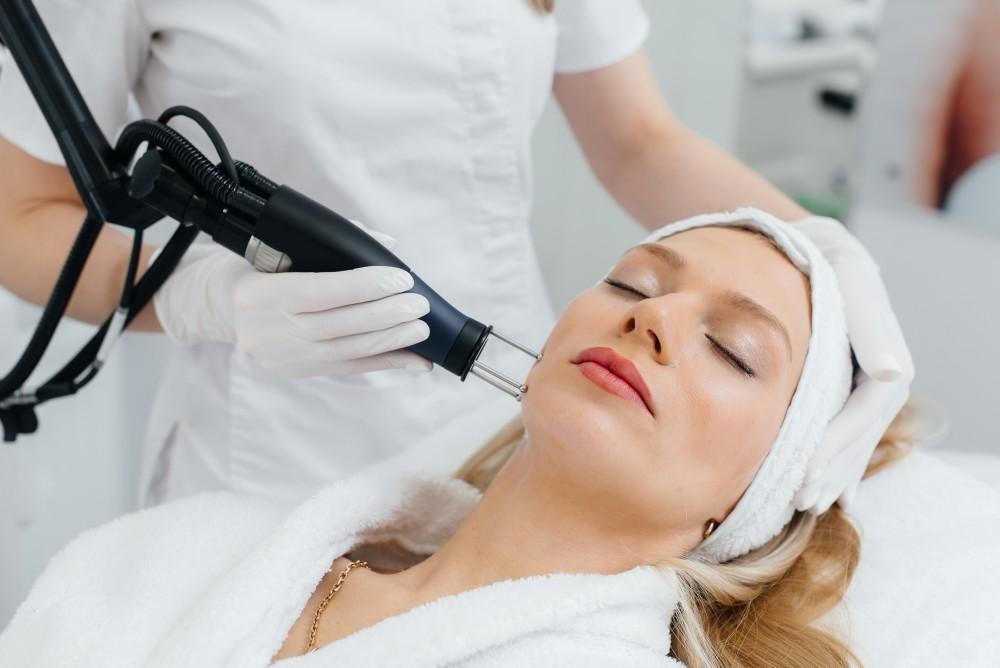
The office looks like something out of a sci-fi movie. The patient is lying comfortably while the device scans her face in real time, automatically adjusting the parameters. This isn’t a vision of the future—this is today, the year 2025.
Picoseconds – a new era of precision
Picosecond lasers are a game changer. They work in ultra-short pulses—we’re talking trillionths of a second. This means the energy doesn’t have time to heat up the tissue. It’s like a hammer blow that shatters the pigment without burning the skin.
I saw the results on a friend after tattoo removal with a traditional laser—scars, discoloration. But now, with picosecond technology? The skin remains virtually untouched. The pigment breaks down into particles so tiny that the body can easily remove them.
The advantage is clear—fewer sessions, faster recovery, better results. This is especially noticeable when removing multicolored tattoos. Blue and green pigments, which used to be stubborn opponents, now disappear without a trace.
Hybrids – the best of both worlds
Morpheus8 is a real hit of 2025. It combines radiofrequency and microneedling in a single treatment. The needles penetrate deep into the skin while simultaneously delivering RF energy. This means we’re working both on the surface and deep within at the same time.
The result? A scalpel-free lift. A dermatologist friend says patients walk out looking like they’ve stepped out of a time machine. Skin is tighter, wrinkles are smoothed, pores are minimized.
Other devices are following this path. Secret RF, Genius—all of them combine different technologies. It’s like having an orchestra instead of a solo violin. Each method does its part, and together they sound perfect.
Artificial intelligence in action
AI is no longer just an add-on—it’s the heart of modern devices. The system scans your skin, identifies its type, thickness, and issues. In seconds, it knows more about your complexion than you do.
Then it automatically adjusts the power, depth, and exposure time. There’s no room for error or an overly aggressive approach. Every pulse is precisely calibrated.
This isn’t marketing—I’m seeing it firsthand in clinics. The devices learn from every treatment. The more patients, the better the results. It’s self-improving technology.
Some systems can even predict the final outcome and display it on the screen before the procedure. The patient knows exactly what to expect.
Home revolution
The home-use device market is growing by 20% each year. It’s wild, but it makes sense.
People want control over their own skincare. The pandemic taught us to be self-reliant. Why should I go to a clinic for a simple procedure when I can do it at home?
Of course, these aren’t professional devices. The power is limited, safety comes first. But for basic care, they’re enough.
Tria, Silk’n, Braun—all have their own versions of at-home lasers. LED masks for light therapy look like Star Wars gadgets, but they work. Microcurrent lifting devices are selling like hotcakes.
I see it among my friends—they have entire collections. LED mask in the morning, microcurrent in the evening, laser on the weekend. It’s a new kind of hobby.
Safety under scrutiny – protocols, risks, and regulations
Agnieszka left the office with a second-degree burn on her cheek. Facial cryolipolysis, which was supposed to be a “safe alternative to plastic surgery.” The problem? The procedure was performed by a beautician without proper training, who ignored the contraindications.
The statistics are clear—complications occur in 5-10% of patients. That’s not a small percentage. The most common causes? Errors in temperature selection, exposure time that’s too long, and skipping the patch test. It was exactly this last step that was skipped in Agnieszka’s case.
| Complication | Cause | Prevention |
|---|---|---|
| Skin burns | Temperature too low, exposure too long | Patch test 24 hours in advance, temperature monitoring |
| Paradoxical hyperplasia | Genetic predispositions, improper technique | Medical interview, appropriate patient selection |
| Permanent discolorations | Improper skin preparation, infections | Sterility, photoprotection before and after the procedure |
The patch test protocol may sound boring, but it’s a lifesaver. 24 hours before the procedure, you apply the device to a small area of skin—ideally behind the ear or on the inner wrist. Temperature: minus 8-10 degrees Celsius for 10 minutes. Then you monitor the reaction. Redness is normal, but blisters or severe pain? You cancel the treatment.
Preparing the patient is no joke. The skin must be clean—no creams, perfumes, or deodorants. You check for a tan—that’s an absolute contraindication. Diabetes, circulation problems, pregnancy—all go on the stop list.
Cooling requires Swiss-watch precision. The temperature must drop gradually, not suddenly. You apply the applicator evenly, without pauses. Duration? Exactly as per protocol—not a minute longer.
Now, a legal note. Since 2023, Poland has enforced a total ban on advertising aesthetic medicine services. Penalties for violating this regulation reach up to 2,000,000 PLN. This is serious. No ads on Instagram, Facebook, or billboards. Even influencers could get into trouble.
The French have gone even further—only doctors can perform cryolipolysis. Here, the debate is ongoing. The Ministry of Health is considering similar restrictions. For now, certified beauticians can work, but the atmosphere is getting tense.
The European Union is pushing for unified regulations. Germany requires at least 120 hours of specialist training. Italy—insurance coverage of 500,000 euros. Poland is still deliberating.
The operator needs not only a certificate but also experience. At least 50 procedures under a specialist’s supervision. Knowledge of anatomy, contraindications, emergency procedures. Because if something goes wrong, every second counts.
Photoprotection after the procedure? Mandatory for at least a month. SPF 50+, even in winter. The skin is as sensitive as a newborn’s.
Safety comes at a price—but how much, exactly?
Balance of profits and costs – market, statistics, and patient satisfaction
Did you know that a single facial laser hair removal treatment costs about as much as a good anti-aging cream? The difference is, the results last for years, not just a month.
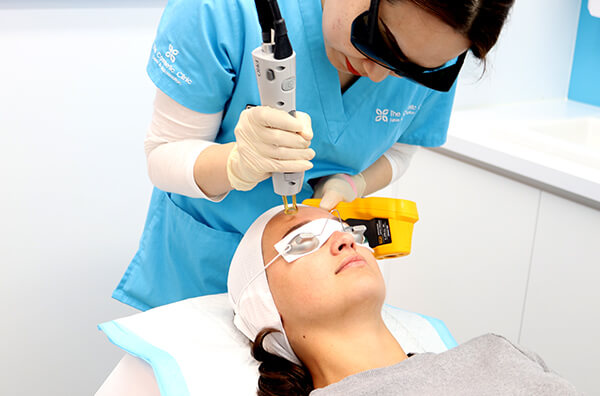
Prices in Poland range from 500 to 3000 PLN per session. In the US, you pay 300-2000 USD, so proportionally it’s quite similar. But when you consider purchasing power… well, it’s definitely a bigger expense here.
The market is booming—forecasts predict it will reach 30 billion USD globally by 2030. That’s almost double compared to today. Polish women are increasingly willing to invest in these solutions, although national statistics are still more modest.
A growth chart for 2025-2030 would show a steep upward line. The base year 2025: around 17 billion USD, then a jump to 22 billion in 2027, and finally the aforementioned 30 billion. The curve would be almost exponential if you drew it on paper.
| Country | Minimum price | Maximum price | Average |
|---|---|---|---|
| Poland | 500 PLN | 3000 PLN | 1200 PLN |
| USA | 300 USD | 2000 USD | 800 USD |
On X, women proudly share their results. “The best decision of my life,” “A year later and still baby-smooth,” “My only regret is not doing it sooner.” Statistics show 80-90% of clients are satisfied. That’s an impressive figure for the beauty industry.
One user wrote: “For years I spent a fortune on epilators and creams. Now I look in the mirror every morning and smile.” Another added: “My husband says I look younger. Maybe it’s the confidence?”
Interestingly, the ban on advertising medical procedures in Poland forces clinics to get creative. Marketing budgets are redirected to staff training and upgrading facilities. Instead of billboards, there’s word-of-mouth and social media. Clinic owners say this paradoxically builds even greater client trust.
Some clinics invest in free consultations as a form of promotion. Others focus on loyalty programs—treatment packages with discounts. Word-of-mouth marketing works better than I expected.
The profitability of a single laser device is about 150-200% over three years. The equipment costs 100,000-300,000 PLN, but with enough clients, it pays for itself quickly. Depreciation plus profit—the math makes a strong case for the investment.
Still, not everyone looks at the numbers with enthusiasm…
Hot debates – doctors’ monopoly, ecology, and the ethics of lasers
“Why should we hand over our profession to doctors who have never studied cosmetology? We’re the real beauty experts!” — wrote one cosmetologist on Twitter, commenting on proposals to tighten regulations on laser treatments.
This statement gets to the heart of one of the hottest debates in Poland’s beauty industry. On one side, doctors are demanding exclusive rights to perform laser procedures, citing safety concerns. On the other, cosmetologists and salon owners are sounding the alarm: this could mean the loss of as many as 35,000 to 70,000 jobs across the industry.
Arguments in favor of a doctors’ monopoly:
- Better preparation for dealing with complications
- Knowledge of anatomy and dermatology
- Greater professional responsibility
Arguments against:
- The cosmetologists have many years of experience in this field
- Doctors are not familiar with the specifics of cosmetic procedures
- Drastic reduction in service availability for clients
The truth is, both sides have their points. I’ve seen salons where cosmetologists have been working with lasers for years and do an excellent job. But I’ve also heard stories of burns and discoloration after poorly performed treatments.
But that’s not the only controversial aspect of lasers. There’s growing discussion about their environmental impact. These devices consume huge amounts of energy—some salons have electricity bills comparable to small factories. Add to that single-use materials, packaging, and medical waste. At a time when every company is expected to think about ESG and sustainability, the beauty industry somehow skirts around these issues.
One salon owner once admitted to me: “I know it’s not eco-friendly, but that’s what clients want. I can’t just shut down my business for the sake of the planet’s peace of mind.”
The deepest divide, however, is about something else—our attitude toward naturalness and aging. Lasers are marketed as a way to “repair” sun damage, solve skin problems, and turn back the clock. But does every wrinkle really need to be fixed? Sociologists are increasingly talking about the pressure of youth culture, which makes women feel obliged to constantly “improve” their appearance.
On the other hand—if someone feels better after a treatment, don’t they have the right to do it? Where does self-care end and obsession with perfection begin?
Clients themselves are divided. Some say lasers are the best investment they’ve ever made. Others regret the money spent and results that didn’t meet their expectations. Still others opt out entirely, choosing to embrace the natural aging process.
All these debates show just how complex the world of modern cosmetics is. There are no simple answers or clear-cut solutions.
How do you make the best decision in such a climate?
Towards Radiant Skin – Next Steps and a Look to the Future
The journey to radiant skin requires not just knowledge, but above all, common sense and patience. Regulations change, technologies evolve, and we need to know how to navigate it all. The most important thing is to remember that every skin has its own rhythm and its own needs.
It may sound cliché, but it really is worth having some kind of action plan. I’ve seen too many women jump at the first offer they see, only to regret it later. That’s why I’ve prepared a simple checklist:
- Check the clinic’s certifications—not just diplomas on the wall, but also current registration with the relevant authorities.
- Ask about experience with your specific type of issue – every specialist has her own strengths
- Ask for a detailed treatment plan with a schedule – avoid places that promise instant miracles.
- Make sure you have access to follow-up consultations—a true professional will want to monitor your results
- Trust your instincts during the first visit—if something feels off, it’s better to walk away.
A competent clinic today is not just about state-of-the-art equipment. Above all, it’s about transparency in practice and a willingness to have honest conversations about the limitations of each method.
What lies ahead in the coming years? Quantum laserotherapy will likely transform how we think about treatment precision. I’m already hearing about projects where AI analyzes skin structure in real time and adjusts parameters accordingly. By 2030, light biopsy could replace invasive tests—imagine getting a diagnosis without the slightest discomfort.
Some laboratories are experimenting with nanoparticles that deliver active ingredients precisely where they’re needed. This is still a vision of the future, but the direction is promising.
Remember, the best technology is the one that’s safe and right for you. Don’t be swayed by the latest trends—sometimes tried-and-true methods deliver better results than the newest inventions. It’s worth consulting an experienced specialist who can help you choose the optimal path.
Zenia
beauty & lifestyle editor
High Class Fashion