
Binding ” up to 1,000 times more water than its own weight.” That’s why hyaluronic acid in Japanese sheet masks isn’t just a trendy buzzword—it really works. In just 10–20 minutes, your skin gets a boost of hydration you can feel instantly. The result? Smoothness and elasticity, often after just one use.
What makes advanced masks stand out?
Not every HA mask is the same. The “advanced” ones focus on:
- Multi-molecular hyaluronic acid (various molecular sizes, including the so-called “Super Hyaluronic Acid”), which penetrates different layers of the skin instead of remaining only on the surface.
- Better fabrics, such as Tencel or hydrogel. They fit perfectly, don’t slip off, and retain more essence.
- Minimalist formulas with a high concentration of active ingredients, without unnecessary fillers.
Simplicity and effectiveness of J‑beauty
J-beauty focuses on what works, not on marketing tricks. Sheet masks fit perfectly into the philosophy of layered skincare (layering), where each step has a specific purpose. It’s a conscious, intentional routine.
In 2026, these masks are more accessible than ever, including in Europe. Innovations continue, and the formulas are becoming even more sophisticated. But where did this fascination with sheet masks come from in the first place?
Advanced Japanese masks with hyaluronic acid
Before the sheet mask appeared on Rossmann’s shelves, Japanese geishas would soak silk sheets in rice and algae infusions. This was even before the Edo period (that is, before 1603), and the ritual had a single purpose: to preserve youthful skin for as long as possible. No one was thinking about mass production back then, but that’s exactly where what we now wear for 20 minutes at home began.
From ritual to laboratory
The real commercialization only began in the 20th century. When nonwoven fabrics and essence stabilization technologies appeared, someone finally came up with the idea to sell ready-made masks instead of making them yourself. But the breakthrough? That was in 2004, when Rohto Pharmaceutical launched Hada Labo with a focus on hyaluronic acid. Suddenly, everyone started talking about HA as the holy grail of hydration.
Milestones of Japanese Masks
A few dates that changed the market:
- 2004 – Hada Labo launches, HA becomes the main ingredient
- ~2006 – the emergence of the Mitomo brand
- ~2013 – Ukiyo-e series (the ones with artistic packaging)
- 2019 – Diamond Beauty award
At the same time, Kose Clear Turn was conquering the shelves as a mass-market leader, those multipacks of 30 pieces for a reasonable price.
The 2010s. This was already a global wave. K-beauty showed the world that masks could be an everyday ritual, not just for special occasions. The Japanese responded with innovations: 3D sheets tailored to the face, nano HA penetrating deeper, Tencel and bamboo instead of regular cotton. Combined functions (brightening plus lifting plus hydration in one) became the norm.
And now? Now we have technology that truly makes scientific sense.
How does hyaluronic acid work in Japanese masks?
Japanese masks use what could be called a “layering strategy”—instead of just one type of hyaluronic acid, they pack in several with different molecular weights. And that’s exactly what makes the difference.
Macro HA (>1,000 kDa) stays on the surface and creates that invisible moisturizing film which locks water into the skin. Micro HA (~100-500 kDa) goes deeper, reaching the middle layers of the epidermis, where the real moisturizing magic happens. Nano HA (<50-100 kDa) penetrates the deepest and provides that “moisturizing from within” effect. Hada Labo Gokujyun or the Koi‑Gokujyun version contain 3+ types of HA—that’s exactly why they work better than Western counterparts with just one variant.
Interestingly, newer forms have also appeared. Hydrolyzed HA ( broken down into smaller fragments), acetylated HA, sometimes called “Super Hyaluronic Acid,” which is absorbed better. There is also 3D/cross-linked HA, which is released slowly for several hours after removing the mask, and fermented HA with improved bioavailability.
Sheet materials and effectiveness
The essences in Japanese masks are thick, highly concentrated, and slightly acidic (pH-balanced), but the sheet itself also matters. Tencel or biodegradable hydrogel will adhere better to the face than regular cotton. ” Jelly masks “—those jelly-like ones—retain moisture even longer, as the sheet itself doesn’t dry out during the standard 10–20 minutes of application.
The end result? The skin receives hydration from the surface down to the deeper layers. It not only looks better, it is actually better moisturized.
Innovations, premium lines, and market trends
If you follow the Japanese mask market, 2026 is essentially the culmination of certain trends that have been building for the past two or three years. The biggest change? Multi-HA has stopped being a curiosity and has become the standard in the premium segment.
Formulas and materials that win
Now there is talk of 3-8+ types of hyaluronic acid in a single mask, often combined with:
- collagen (this one really works externally for hydration)
- with ceramides and niacinamide (for barrier protection)
- with peptides and retinol derivatives (anti-aging focus)
- plant extracts such as centella, licorice
Materials have changed as well. Tencel and other plant fibers have almost replaced cotton, while hydrogels and jelly masks retain moisture longer and adhere better. The result? A mask that truly doesn’t dry out after 15 minutes.
Market and premium
Specialized variants are now the norm: anti-aging, brightening, barrier repair, sensitive. Lines such as Quality 1st Derma Laser (nanocapsules, laser technology in the name is more marketing than technical, but the formula is strong) or Utena Premium Puresa are setting the direction. The global sheet mask market is valued at around 350-400 million USD, with forecasts indicating a CAGR of 3-9%+, and Japan accounting for about 15% of the share. That’s quite a lot for a single country. The question is, how do you choose the right one for yourself from this range?
Composition, material, and skin needs
Start with a specific skin concern, as this will narrow down your choices the fastest. Dry skin with a weakened barrier? Look for HA plus ceramides. This combination hydrates and seals at the same time. Sensitive skin is a different matter: here, fragrance-free and alcohol-free formulas work best to avoid further irritation. Uneven skin tone benefits from HA paired with niacinamide, as together they brighten more effectively than alone. And if you’re thinking about anti-aging, opt for HA with peptides or retinol derivatives.
The material of the sheet also makes a difference
Tencel may sound like marketing, but it’s actually gentler and biodegradable — great for sensitive skin and your conscience. Hydrogel or jelly sheets have better adhesion, cling like a second skin, and create an “occlusion effect” that helps ingredients penetrate deeper. I wouldn’t exaggerate the difference, but it is noticeable.
Packaging and labels
Single sachets or multipacks? Multipacks (usually 4-50 pieces) with zip-lock closures are more convenient and generate less waste. On the labels, look for terms like “brightening” or “rozświetlanie”—in the EU, this means evening out skin tone, not whitening. Check the pH balance and allergen list, especially if your skin is sensitive. Label language can be confusing, but once you understand the key terms, making a choice becomes much easier.
Error-free use
For the Japanese hyaluronic acid mask to work properly, the order matters. It’s not just about putting a piece of fabric on your face and waiting. It’s a bit like cooking — you can have the best ingredients, but if you combine them incorrectly, the result will be mediocre.
Steps and application time
- Cleansing – the skin must be truly clean for the active ingredients to penetrate where they should.
- Toner or softener (optional) – some people like to lightly moisten the skin before applying the mask to help it adhere better.
- Mask for 10-20 minutes – no longer, because the material starts to dry out and can actually draw moisture back out. Seriously, do not exceed this time.
- Patting in the remaining serum – whatever is left in the sachet or on your face, pat it in with your fingers, don’t rub.
- Cream or oil for “sealing” – otherwise, hyaluronic acid may evaporate; it needs occlusion.
Tips and safety
Frequency: 1-3× per week as a routine, or occasionally after travel or sun exposure. You’ll notice results after just one use (smoothness, radiance, hydration), so there’s no need to overdo it.
A few tricks: chill the mask in the fridge before use if your skin is irritated. Use any excess essence on your neck and hands—nothing will go to waste.
If you have sensitive skin, do a patch test for 24 hours. Combine carefully with retinoids and acids, as an HA mask may increase the penetration of other ingredients. Choose fragrance-free and alcohol-free formulas if you are reactive.
At the intersection of ritual and science
Japanese skincare has always balanced between philosophy and laboratory, but today’s hyaluronic acid masks show that these two worlds can support each other. The ritual of applying a mask in silence, slowly spreading the product, those several minutes of breathing—this is more than just tradition. It’s a time when the ingredients truly work, penetrating the skin as stress decreases. Science confirms that lower cortisol levels support cell regeneration.
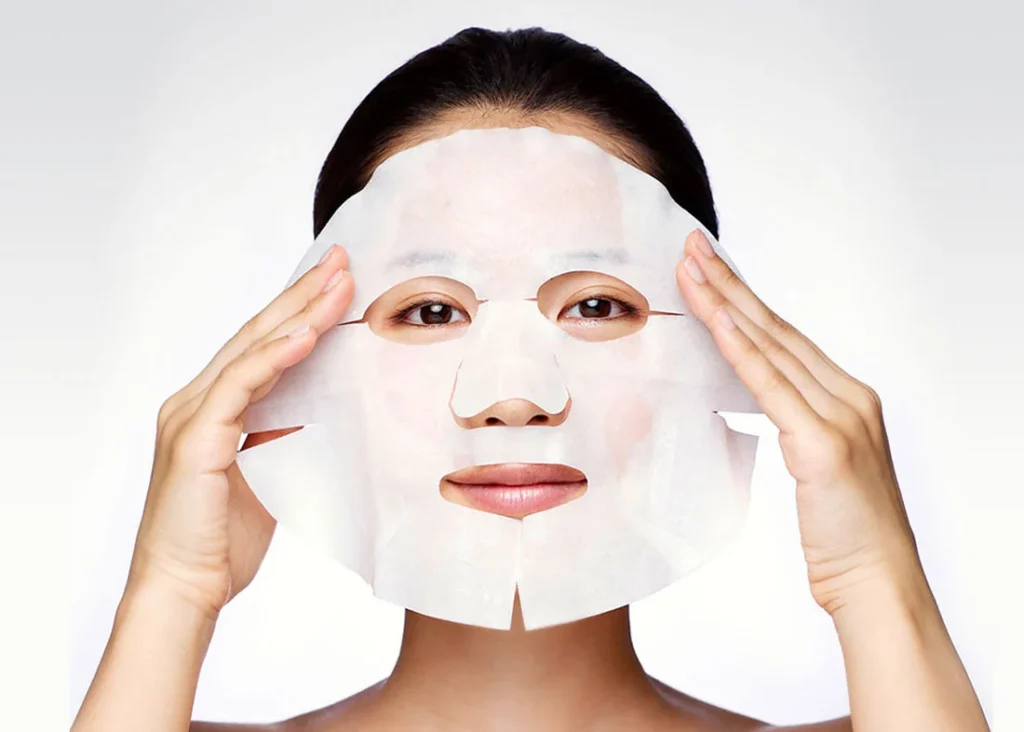
Interestingly, Japanese women have known this for generations, even without our clinical studies. They intuitively connected calmness with results. Now we have formulas that harness this knowledge: various hyaluron molecules adapted to the rhythm of the skin, fermented extracts prepared according to tradition, and modern ingredient delivery technologies.
And that’s exactly what makes these products work—not just because of the chemistry, but the entire experience. You can’t separate the two.
Rene
HCF editorial team