
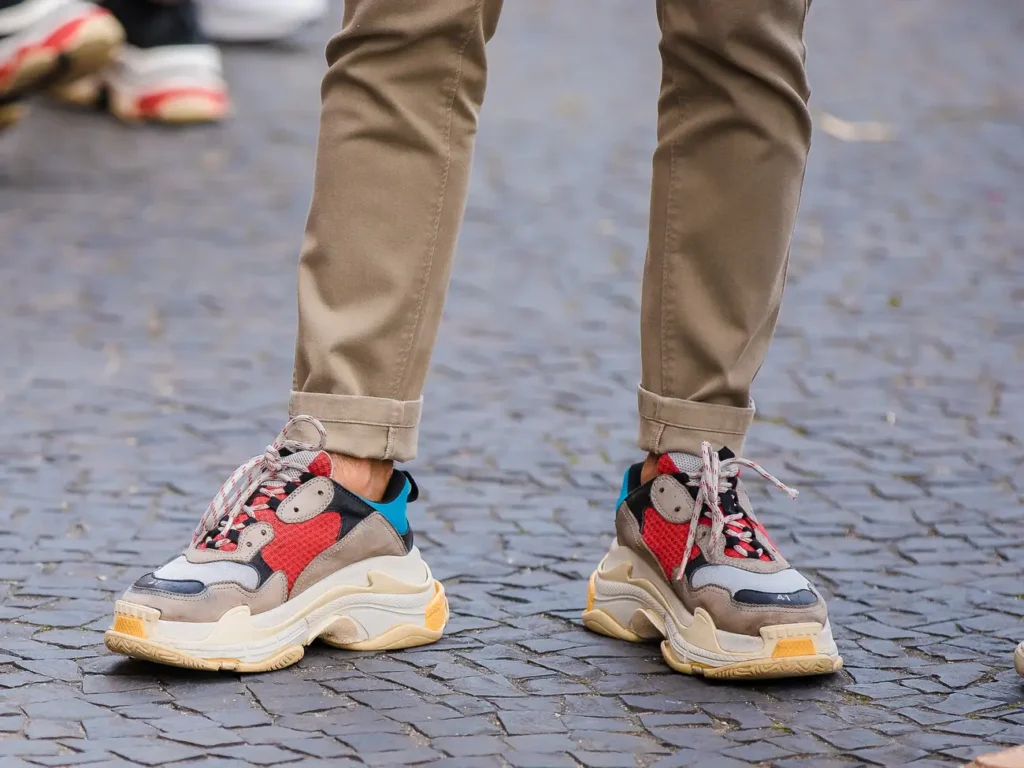
Just ten years ago, sporty sneakers were… well, sporty. Today, I see Triple S on the red carpet next to a suit worth several thousand dollars. How did it happen that shoes which look like a combination of three different second-hand models are selling for $895 and disappearing from shelves in no time?
How did Balenciaga turn sneakers into luxury?
Balenciaga under Demna’s direction redefined luxury in sneakers, starting with the Triple S in September 2017. The “Destroyed” model from 2022, deliberately distressed at the factory, cost $1,850 per pair (they produced only one hundred pairs). The brand’s revenue in 2021 reached 1.189 billion euros, a 44% year-on-year increase. In 2025, Demna was succeeded by Piccioli, and new campaigns for 2026 are announcing the Triple S.2 and the Radar model.
I will walk you through the entire history of this premiumization, we’ll take a look at the market mechanics, examine the technology and materials, and finally, of course, the debate over taste and real value.
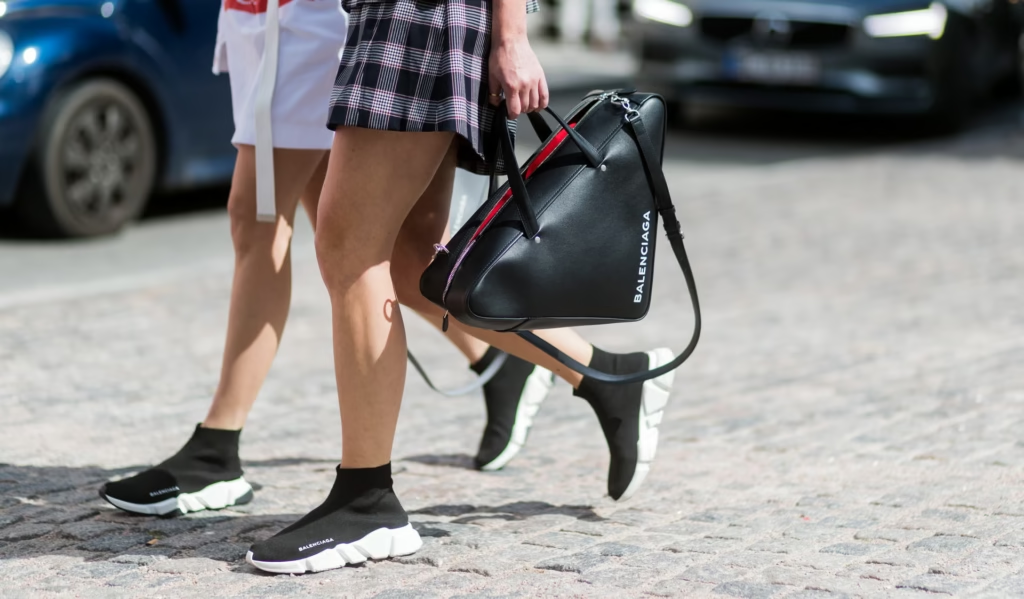
History and market: how did sneakers become premium?
Balenciaga has evolved from a Spanish fashion house (founded in 1919) to a global architect of the luxury sneaker market. The turning point? Triple S.
Milestones 1919-2026
A brief timeline that shows the scale of the changes:
| Year | Event |
|---|---|
| 1919 | Cristóbal Balenciaga founds a fashion house |
| 2015 | Demna Gvasalia takes the helm |
| 01.2017 | Triple S debuts on the runway |
| 09.2017 | Retail (850-895 USD), sold out within hours |
| 2018 | Track, the “Made in China” scandal, production in China |
| 2019 | Revenue 1 bn EUR |
| 2021 | 1.189 bn EUR (+44% y/y) |
| 2022 | “Destroyed” for 1,850 USD |
| 2025 | Demna leaves, Piccioli takes over |
| 2026 | Triple S.2, Radar; Q1 growth in the Kering group |
Why did it work on the market
The price became a status symbol. $850–1,390 per model, limited editions, instant sell-outs. This fueled the investment effect, resale exploded. Gucci and LV followed suit, Zara released knock-offs within a week. “Ugly chic” stopped being a provocation and became the norm.
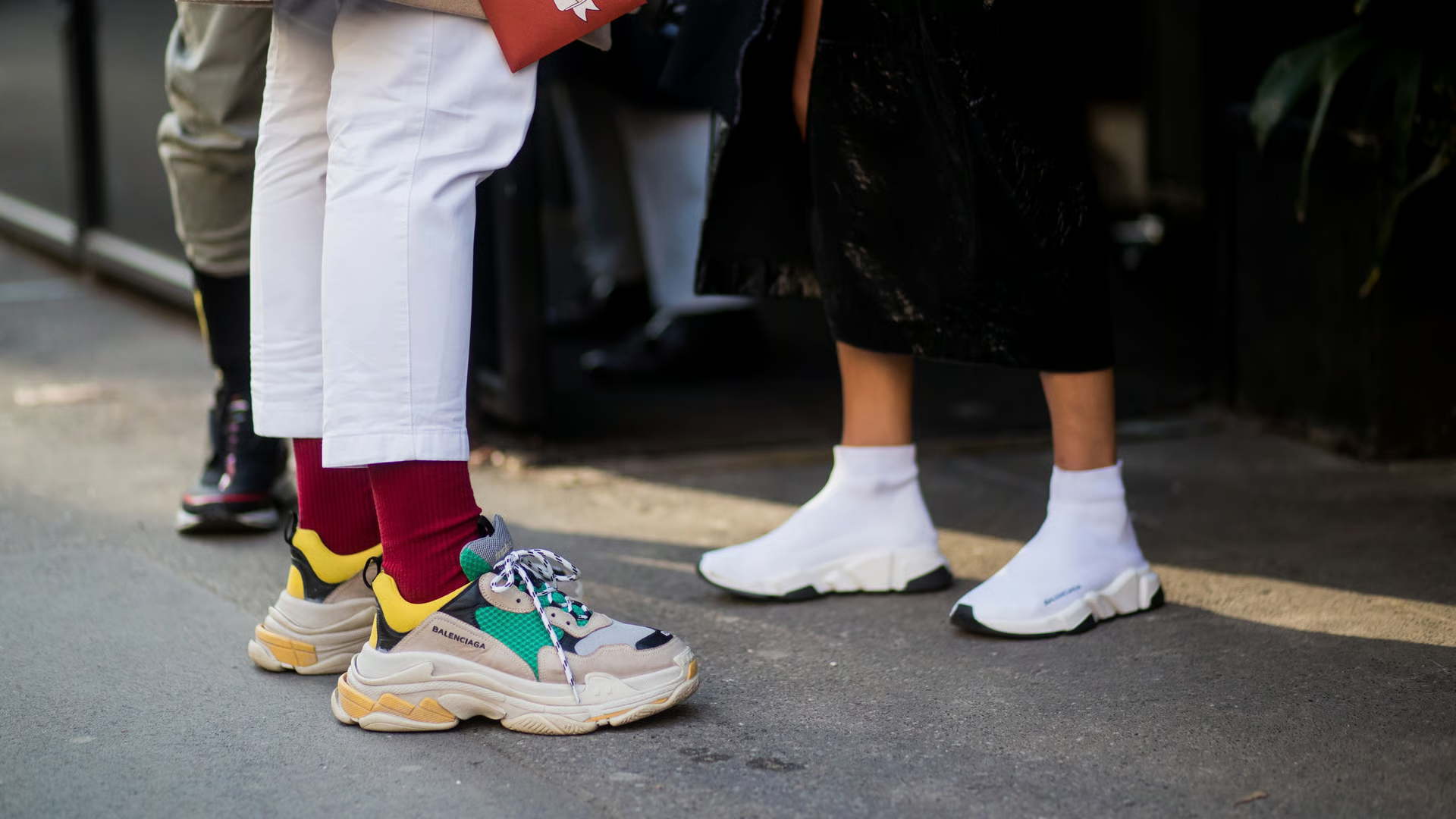
But there were disputes. “Ugly” or “iconic”? In 2018, the MIC scandal hit the premium image. Counterfeits flooded the market, even authenticators have trouble verifying them. In the 2026 campaigns, Piccioli focuses on evolution, not revolution, and sales remain strong.
Projects, materials, and innovations
Balenciaga doesn’t make sneakers “by eye.” Every model is a precise construct designed to justify its price and status. Triple S? That’s three soles from different disciplines—running, basketball, track—combined into a single hybrid form with a height of 6.5 cm. Patchwork upper, 3M reflective detail on the toe, terry cloth insole. The first pairs were genuinely heavy, because injection-molded rubber plus memory foam are no featherweights.
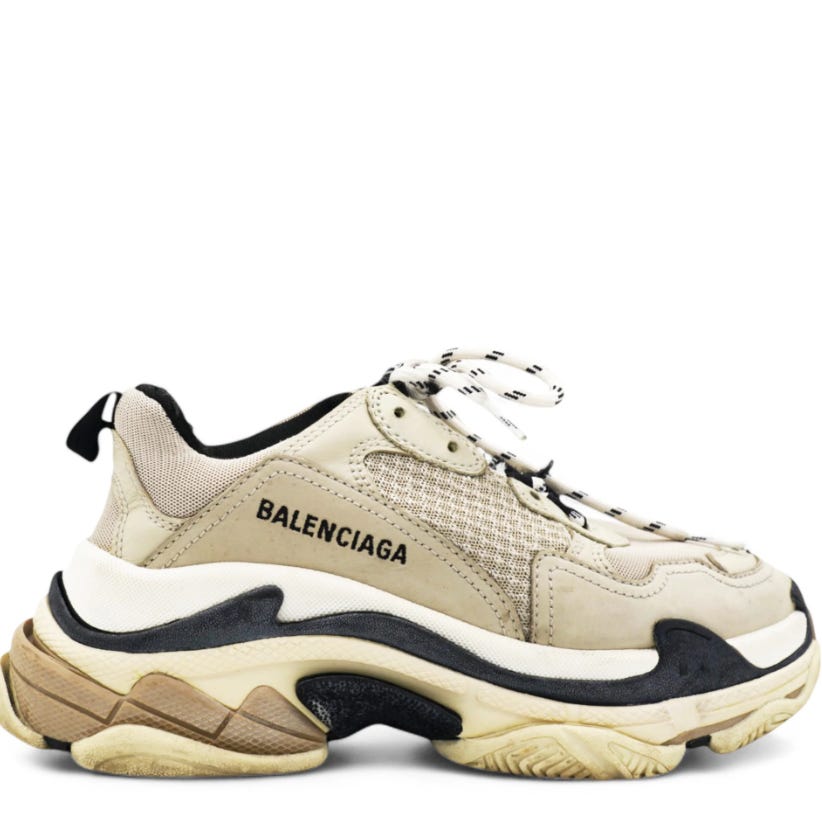
Key models and their DNA
| Model | Year | Distinctive features |
|---|---|---|
| Triple S | 2017 | 3-layer sole, 6.5 cm, 3M reflective strip |
| Speed Trainer | 2016 | “sock-like” collar, knitted upper |
| Track | 2018 | multi-panel (hiking/running), ~68 components |
| Defender | 2020 | “monster truck” profile, extremely high |
| Triple S.2 | 2026 | elongated silhouette, mesh, controlled patina |
| Radar | 2024 | slim, 360° lacing |
Demna once said that the Triple S is, for him, a “3D sculpture – stable, masculine.” And you can see it in the construction. The Track goes even further: a multi-panel chaos that, only up close, reveals itself as a thoughtfully designed system.
Materials and sustainable innovations
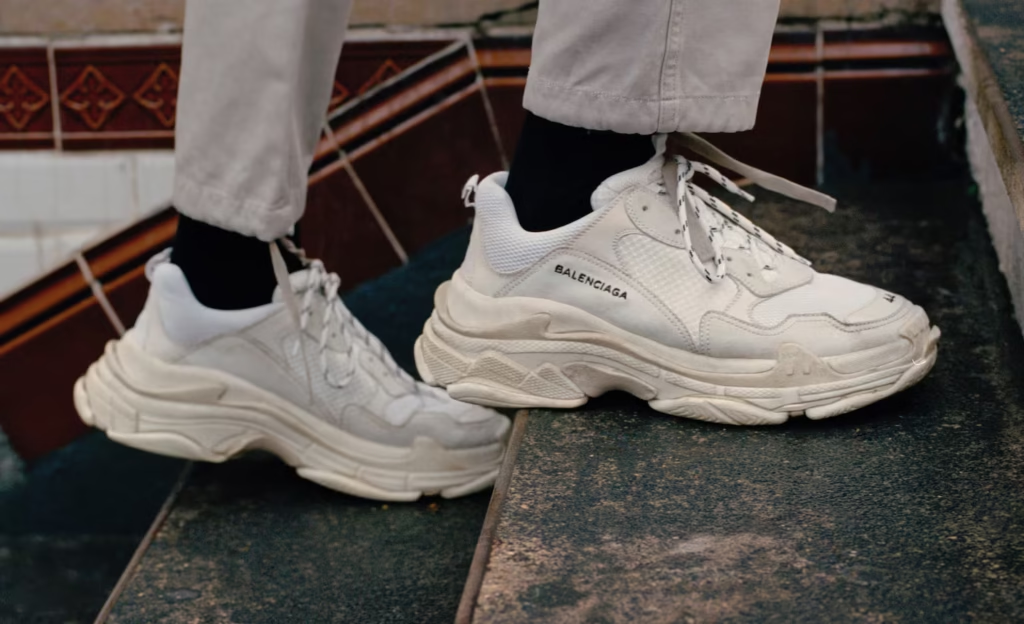
Leather, suede, mesh, jersey – the classics. But from 2024 Balenciaga is introducing Bananatex (100% plant-based, biodegradable, zero plastic) and announces AMSilk for the S/S 2026 season: a bio-material that uses drastically less water than traditional production. Recycled rubber in the soles is already standard.
Production? Initially Italy, since 2018 China and Portugal – expertise in dyeing and washing made it possible to create lighter versions without losing character. Sizing is TTS, though for wide feet it’s worth adding +0.5 EU.
Luxury that teaches you to see differently
Balenciaga shifted our perception of shoes from thinking of them as tools to seeing them as sculptures. The Triple S didn’t have to be comfortable or beautiful in the traditional sense; it had to say something about who you are. And it did. This shows how luxury works today: it’s the narrative that matters, not the material. The fashion industry has learned that people pay for the story, for belonging, for something that provokes a reaction.
What remains after the hype? Probably less noise, but the idea itself has caught on. “Ugly” has stopped being an insult and has become an aesthetic. And sneakers? They turned out to be the loudest chapter in this story about what luxury can be when it stops being afraid to experiment.
Sausage
editorial team
High C