
The lines on Rue Cambon looked like a scene from “The Hunger Games.” Clients waited for hours to enter the boutique right after Matthieu Blazy’s debut show in April 2025. On TikTok, unboxings from Chanel flooded timelines within days, and the media estimated the reach of the first show at $55.8 million in publication value. We last saw this scale of hype… well, actually, probably never before in the context of a fashion house that had operated in such a stable, predictable mode for 40 years.
This is the first truly major creative change at Chanel since the days of Karl Lagerfeld. And it’s not just about another season, but about the moment when the brand once again becomes the number one topic. Not because it has to, but because people want to talk about it.
The new era of Chanel – why now?
Because finally, something is happening. Blazy officially launches in April 2025, but the entire industry is already analyzing every detail. In the following section, we’ll break down this myth of desire into specifics: where it came from, what it actually revealed, what numbers are behind it, and whether it’s truly a revolution or just brilliantly managed anticipation. The question is: will Chanel set trends once again, or merely keep up with them?
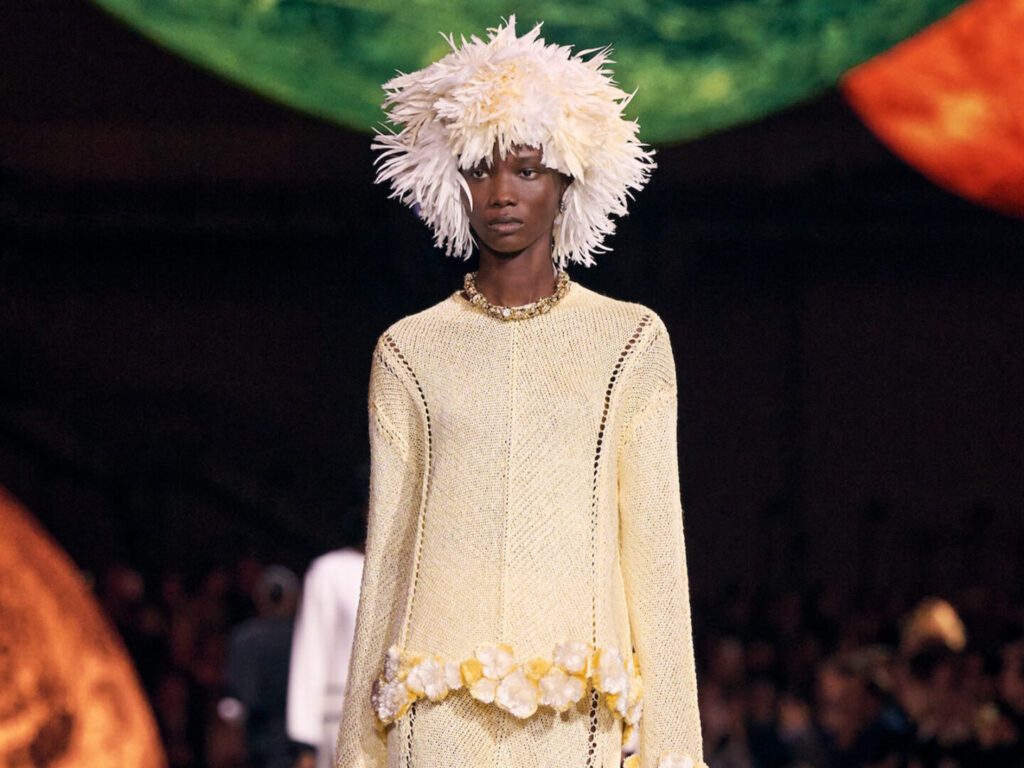
From Coco to Blazy: a shift at the helm of Chanel and what led up to it
Let’s start with the basics, because without them it’s hard to understand why choosing Blazy is such an earthquake. Coco Chanel founded the house in 1910 and immediately began breaking the rules. No. 5 in 1921? A revolution in perfumery. The 2.55 handbag from 1955? A symbol of freedom, because at last you could have your hands free. All of this sounds obvious today, but back then it put fashion on a completely new track.
From Lagerfeld’s spectacle to Viard’s impasse
Karl Lagerfeld took the helm in 1983 and turned Chanel into a pop culture icon. Shows became theatrical spectacles, commercial success soared, and the logo was everywhere. He worked for 36 years, right up until his death in 2019. Then came Virginie Viard, his longtime collaborator. She was meant to continue the legacy, but in June 2024 she left after criticism that the collections were “drab, lifeless.” Clearly, something was not working.
Return on December 12, 2024
The nomination of Matthieu Blazy last December was a signal: an end to safe continuity. The fourth artistic director in 115 years is no coincidence, but a conscious choice of craftsmanship over publicity. The start in April 2025 marks a new chapter. Bruno Pavlovsky and Leena Nair have chosen vision and modernity, not a celebrity face. And this is where the real change begins, because Blazy did not come just to fill positions. He came to rewrite the rules.
Codes rewritten for now: aesthetics, craftsmanship, and movement at Blazy
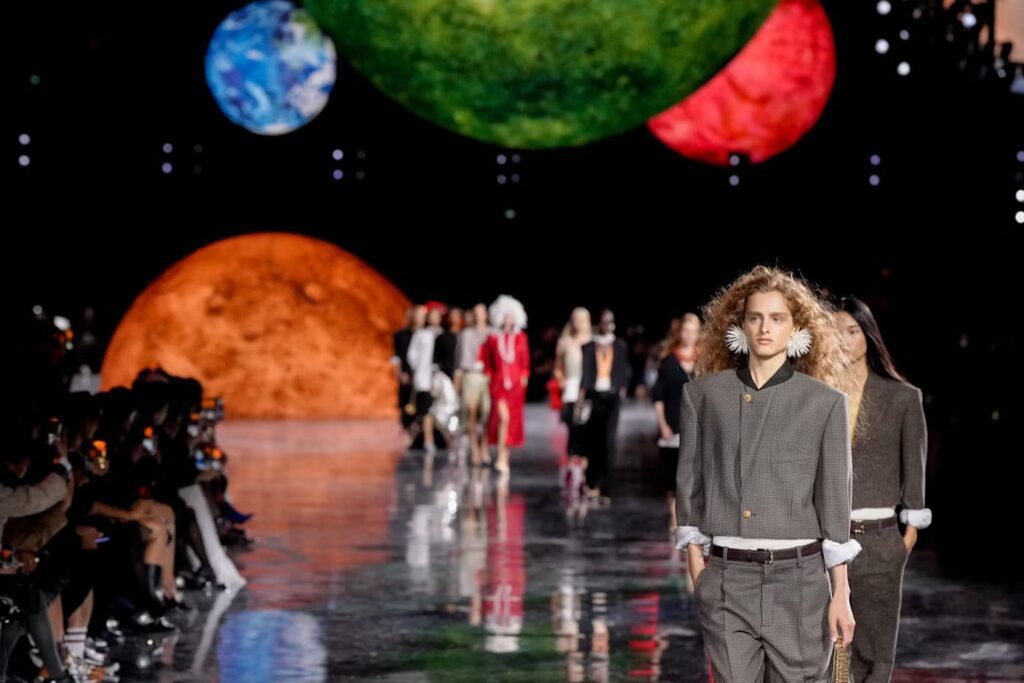
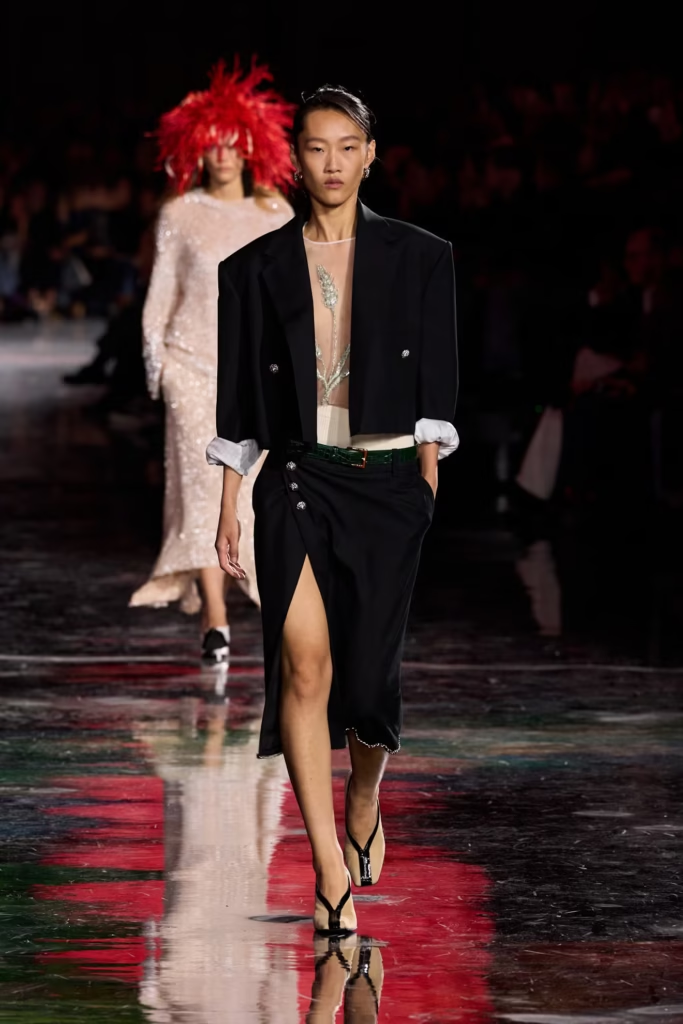
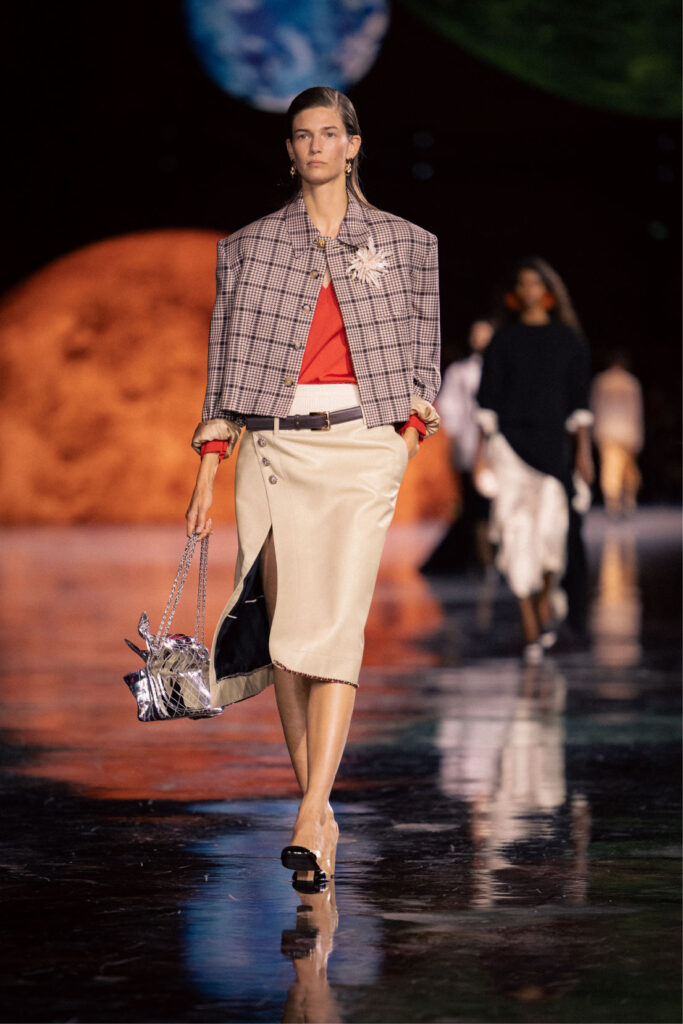
Blazy approaches the codes of Chanel as if they weren’t sacred, but rather a starting point. Tweed? Okay, but let it be frayed, with raw edges, or printed—a field for experimentation, not a museum exhibit. The little black dress stops being a costume for special occasions; it gets a boxy cut, a dropped waist, sometimes a collage of organza. This is exactly the idea of ” wardrobe in motion “—clothes are meant to move, to breathe, to work with the body, not to discipline it. Coco Chanel designed for women who wanted to be free. Blazy takes that freedom and adds sensuality, tactility, and a touch of subtle decadence.
Techniques and details that create a new code
Favorite moves list? Here they are:
- plumes applied to tweed (because why not)
- streamers and fringes as finishes that have a life of their own
- grained calfskin and soft lambskin in bags – a touch that lingers in memory
- marinière made of jersey, or stripes straight from the everyday wardrobe
- slingbacks cap-toe – classic, but comfortable
- east-west flap as a new handbag icon
Scenography? It’s not just a backdrop. Cosmic spheres, the Paris metro for Métiers d’Art, cranes symbolizing “work in progress,” mushrooms on couture. Every show is a manifesto: a caterpillar turns into a butterfly, the practical becomes fantastic. Or the other way around, depending on your perspective.
Chanelmania in numbers: demand, prices, media, and boutiques
Queues in front of the boutique on Rue Cambon were compared on TikTok to “The Hunger Games.” Sounds like an exaggeration? Not necessarily. The house introduced limits of ” one bag per customer,” and collections were selling out in days, not weeks. Gen Z filmed Chanel shopping hauls like trophies. This wasn’t hype, it was a frenzy.
Demand and media: the scale of the phenomenon
The numbers speak for themselves:
- Media impact after debut: 55.8 million USD (+73% y/y)
- Brand valuation: 38 billion USD (Brand Finance 2025)
- Viral hauls: TikTok flooded with Gen Z unpacking bags
Blazy awakened something in Chanel that hadn’t been there for years. Maybe not since the days of Lagerfeld, it’s hard to say. But the effect is plain to see.
Prices, availability, and expansion
At the same time, the house was preparing for the long game:
- Revenue 2024: 18.7 billion USD (‑4.3% y/y)
- Operating profit: $4.48 billion (‑30%)
- Capex: 1.755 billion USD (+43%)
- Brand expenditure: 2.445 billion USD
Investments were growing, even though results were declining. Chanel was playing for the future.
Prices? Small Flap 5,100 USD, Small Shopping 5,400 USD. In the USA, increases of 2-5%, and the SS26 collection launches on 03/13/2026. Plus, 48 new boutiques in 2025: India, Mexico, China, Japan, Canada.
The house was expanding its empire at a time when others were holding their breath. Risky? Perhaps. But the belief in the Blazy effect was evident.
Perspectives and controversies: praise, concerns, and what’s next
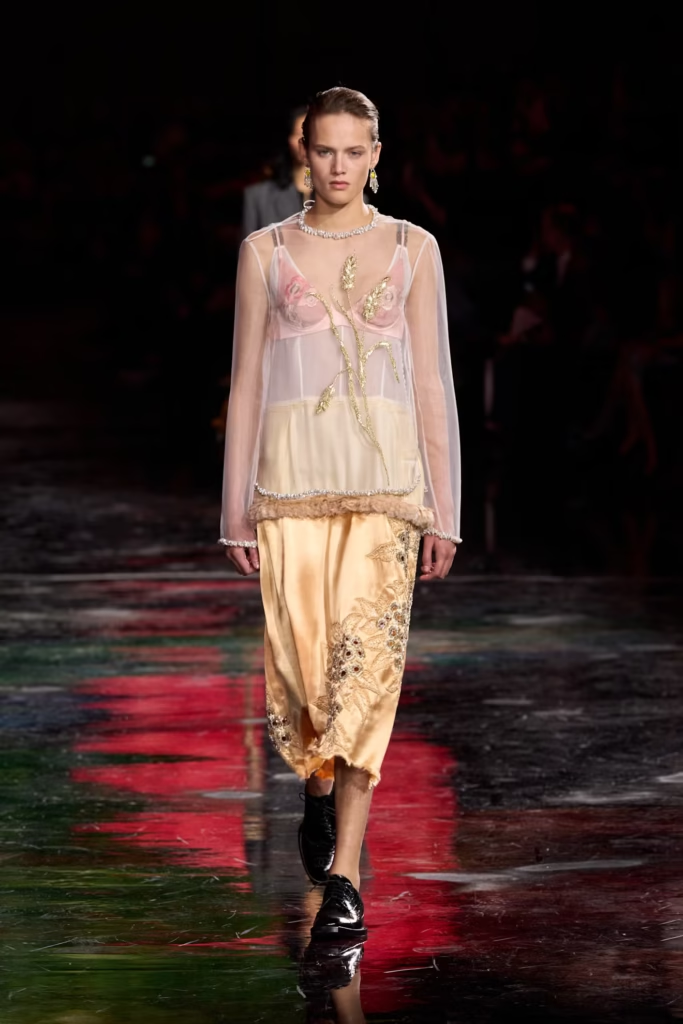
The fashion industry hasn’t seen such a split in opinions in years. On one hand, you have reactions like “epic,” “out of this world,” “a seismic shift,” Cathy Horyn wrote about “an extraordinary sense of Coco’s spirit,” and Pavlovsky himself spoke of “pushing boundaries.” On the other? Comments that it’s “too Bottega-like,” “not grandma’s Chanel,” with some traditionalists outright using the word “frumpy.” And then there was that April Fools’ joke about Blazy supposedly leaving, which had to be clarified—showing just how nervously the market awaits every signal.
Why does the industry talk about “the democratization of luxury”
Because you see something that wasn’t there in Chanel before. Looser cuts, fabrics that are cheaper to process (although prices haven’t dropped at all—in fact, they’re rising by 2-5% in the US), an aesthetic that feels more wearable than museum-like. For some, this is the brand opening up to younger generations; for others, it’s a loss of DNA. The debates also concern the details—some say certain patterns don’t fit perfectly, and the finishing is inconsistent in places. But this very “imperfection” might be intentional, because now luxury wants to look alive, not like an exhibition.
Risks and growth vectors
What’s next? The market expects a rebound after the decline in 2024. Geographic expansion continues (NYC and more cities), and there is speculation about a men’s line, which would be logical after Bottega’s success. Balance? Blazy has already shown he can do eco without eco-posturing. And his impact on mass culture is plain to see—his aesthetic codes are quickly making their way into fast fashion and aftermarket platforms (eBay is full of “Blazy vibes”). The question is whether this will strengthen the brand or dilute it. We’ll see in a year.
Finale: a home that breathes with movement again
Matthieu Blazy wrote a story that we are now rereading: the body returns to the center of fashion, and movement is no longer just a metaphor. What we saw on the runway and in the reactions of the audience sounds like a verdict for the years of stagnation. Chanel once again becomes a house where clothes respond to how we move, touch, and live. It’s not about a revolution in structure, but about restoring intuition.
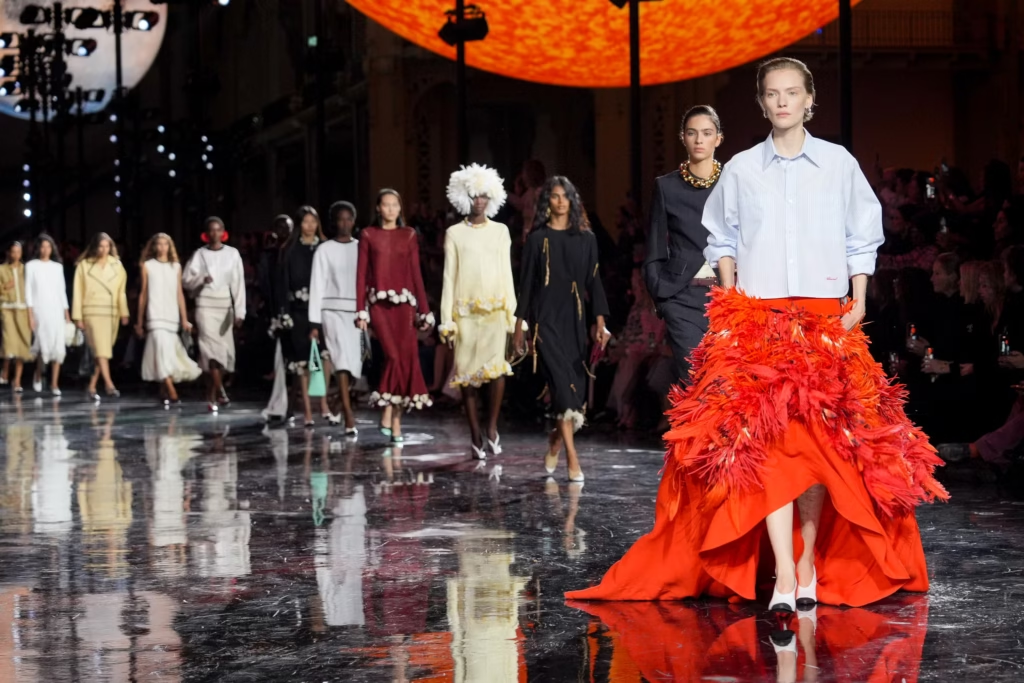
And that’s exactly what makes this change significant beyond just the brand itself. Because when a house of this scale treats movement as a starting point, it says something about all of us: we want clothes that understand, not just represent. Blazy understood this and did something simple, yet bold.
The rest is just a matter of time and upcoming collections. But the moment has been captured.
ST XX
business editorial team