
Okay, you’ll probably admit that the topic of designer sunglasses seems boring. But 2026 is changing the rules. Ray‑Ban Meta is already topping the bestseller list on Skąpiec.pl (04.2026), because it’s not just lenses, but smart technology in a retro frame. At the same time, the SS26 runways exploded with oversize (Celine, Prada). And you know what? I think it’s no longer just a whim.
Ranking of designer glasses 2026 and why this year is groundbreaking?
First of all, UV400 is no longer a premium add-on; it has become the standard. Over 70% of top models in the rankings now feature polarization, so comfortable, glare-free vision is not a luxury but the norm. Secondly, women make conscious choices: they compare protection, aesthetics and gadgets in one. It’s a combination of eye health, fashion, and real practicality.

In this article, you’ll get clear evaluation criteria (durability, UV protection, style), leaders of the Polish market with price ranges, global recommendations, and key technologies of the year. I won’t bore you with full specification lists; instead, I’ll show you why these particular models are winning in 2026. So let’s move on to how we actually assess sunglasses in the ranking, shall we?
How the ranking is created
The ranking combines data from several independent sources. This way, I merge sales popularity with expert opinions and style trends.
The weighing method? Well, it’s a mix of quantitative and qualitative data. I count sales ranking positions, but the opinions of opticians and editors who test the glasses in practice are just as important. It’s not just about the numbers.
Evaluation criteria and quality standards
When evaluating, I take several things into account:
- UV protection – I require the UV400 standard, meaning 100% blockage up to 400 nm. This is the absolute minimum.
- Polarization – essential when driving and near water, reduces glare.
- Durability – materials, finish, scratch resistance.
- Innovations – smart features (if available), interchangeable lenses, premium technologies.
- Style and trends – because honestly, appearance matters.
- Value for money – not everyone wants to spend a fortune.
In practice, I use category 3 (8-18% light transmission) as the default for sunlight with premium. This is in line with optical standards for everyday use in Poland.
I update the ranking on an ongoing basis, as the season and availability change. I treat it as a “living” document, not a rigid list from the beginning of the year.
Global perspective: segments, styles, and recommendations 2026
International lifestyle publications divide glasses into three segments, making the choice easier. We have everyday (casual comfort), performance (sports and activity), and luxury (finish and prestige). Men’s Health in the 2026 edition lists Ray‑Ban (everyday), Oakley (performance), Tifosi (affordable sport), Warby Parker (value), and Oliver Peoples (luxury). GQ follows a similar path: Ray‑Ban, Persol, Oakley, Jacques Marie Mage, Chimi (with an emphasis on UVA/UVB), Oliver Peoples, and Carrera. It’s clear that Ray‑Ban and Oakley appear everywhere, regardless of the segment.
What the SS26 runways dictate
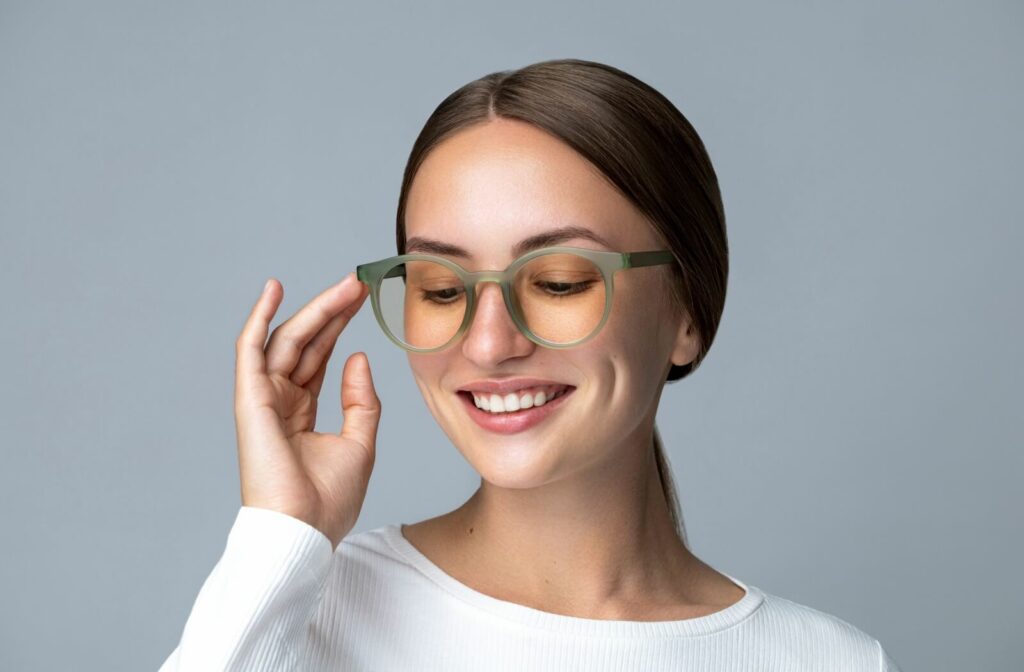
Spring-summer 2026 runways showcase two main directions: oversize and retro-futurism. Celine and Prada present huge frames reminiscent of the ’70s, but with a modern twist. At the same time, the Y2K aesthetic is making a comeback—those “goggles” from the early 2000s. Glasses are once again becoming accessories that define the entire look, not just complement it.
Smart glasses in fashion 2026
Ray‑Ban Meta (2023+) is an example of the growing category of smart glasses. AI, video recording, audio features—all in a classic frame. It’s not about technology for running, but about weaving intelligent functions into your everyday look. The category is still taking shape, but interest is growing, especially among people who want discreet technology without a gadget-like appearance. We’ll see how this develops, as for now it’s still a niche segment, though with great potential.
Technology and protection: UV400, polarization, and quality standards
I choose glasses mainly based on appearance, but lens technology really makes a difference and it’s worth knowing what to look for. A few key parameters separate good branded models from cheap ones, and these seriously protect your eyes.

UV400: the gold standard of protection
The label “UV400 – 100% UVA/UVB up to 400 nm” is not a marketing gimmick, but an actual barrier against radiation that can lead to cataracts or pterygium (a fleshy growth on the cornea). In the premium segment, it’s an absolute must-have. If you only see “UV protection” without specifics, be careful—it might block barely half of the harmful spectrum. UV400 gives you the certainty that everything up to 400 nanometers is blocked. Simple as that.
Polarization and visual comfort
Polarizing filters reduce glare by 50-90% (depending on the study), which transforms your experience when driving or spending time by the water. Instead of squinting at wet surfaces, you see clearly and comfortably. According to industry data, over 70% of top models in 2026 rankings offer polarization—it’s practically a standard in the higher segment. For drivers and physically active people, this is a feature you’ll appreciate every day.
Filter categories and lens materials
Filter categories indicate how much light they let through:
- Cat. 0-1: 80-100% / 43-80% – low lighting, mostly fashion
- Cat. 2: 18-43% – moderate sun
- Cat. 3 (8-18% light transmission): standard protection for strong sunlight – most summer sunglasses
- Cat. 4: below 8% – high mountains, glaciers; not accessible by car, as regulations prohibit it
As for materials: glass offers optical clarity and scratch resistance (but is heavy), polycarbonate is armor for athletes (lightweight, doesn’t crack), and photochromic lenses (like Transitions) react to light and adjust automatically. The choice depends on what suits you best – I prefer polycarbonate in summer because I’m never afraid of dropping them.
The world through the right lenses: the ultimate perspective 2026
Choosing glasses in 2026 is no longer just a matter of vision or fashion. It’s a decision that combines technology with everyday comfort, aesthetics with functionality, and branded quality with real-life use. I can see how all these elements are starting to intertwine, creating a market where even the smallest details (like the way light is filtered or the frame material) truly matter.

What I find most interesting is that conscious choice is no longer the domain of experts. More and more people simply know what they are looking for and why, and
Because ultimately, it’s about seeing better and feeling good in what we wear on our nose every day.
Snu poo