
When John Galliano announced a two-year partnership with Zara in March 2026, the fashion industry responded with a collective, resounding “Well, actually.” Here was a designer whose shows in the ’90s and early 2000s turned runways into theatrical spectacles, who was synonymous with couture at Maison Margiela, returning to the mainstream. The first collection is set to debut in September 2026, and honestly, the fascination with the Galliano name hasn’t faded, even though it’s been decades since his greatest successes.
Why does his name still electrify the fashion world?
It’s a blend of scandal and genius. Galliano (born November 28, 1960, Gibraltar) transformed the fashion show into a spectacle full of historical references, deconstruction, and drama. In 2004, he ranked fifth in the BBC poll of the most influential figures in British culture, so we’re talking about icons on the level of Kate Moss or David Bowie. At the same time, he’s someone who went through a personal and professional disaster in 2011, so the question intrigues us: what’s next? How does a designer who’s been at the top and fallen to the bottom redefine modernity once again?
In this article, we will go through his career, design language, that crisis, and what the return to mass fashion means. Because Galliano still has something to say.
Who is John Galliano?
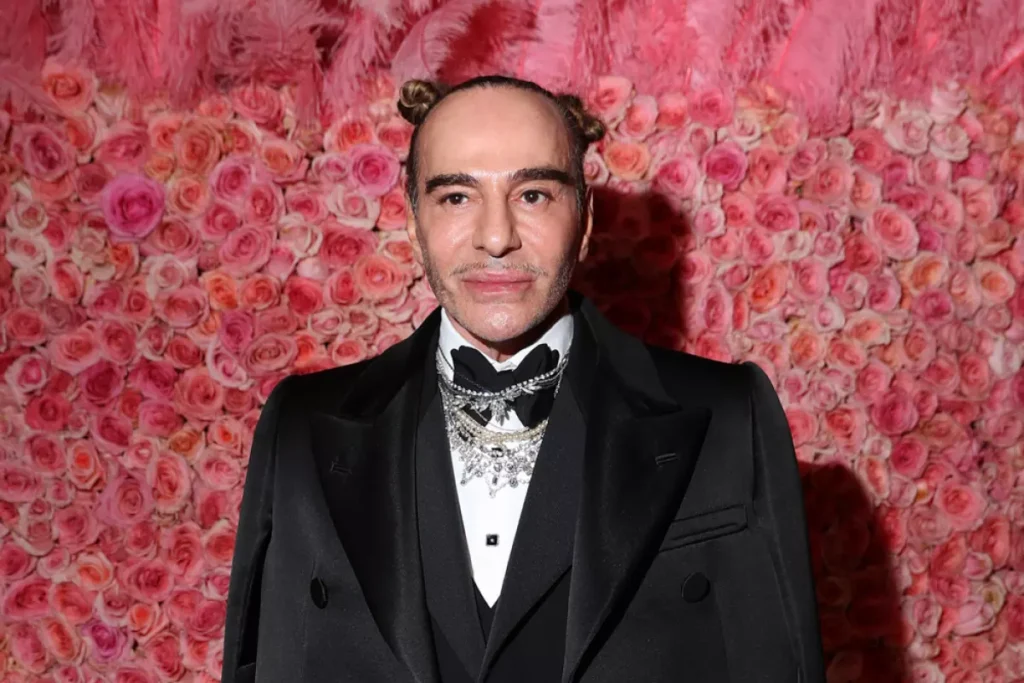
Juan Carlos Antonio Galliano-Guillén was born on November 28, 1960, in Gibraltar. Juan’s father worked as a plumber, and his mother, Ana Guillén, was a flamenco dancer. At the age of six, the family moved to London, settling successively in Streatham, Dulwich, and Brockley. Young John quickly absorbed the atmosphere of the British capital in the 1970s.
He graduated from Central Saint Martins (1980-1984) with honors. His graduation collection, “Les Incroyables “, inspired by the French Revolution, was entirely purchased by the London boutique Browns. That was the moment when the fashion world first heard the name Galliano.
From Givenchy and Dior to Margiela and collaboration with Zara
The early years of his career were not easy. Financial problems forced him to move to Paris in 1989. His first show in the fashion capital took place in 1991. The real breakthrough came later:
- Givenchy (July 1995) – the first Briton to head a French haute couture house
- Christian Dior (October 1996 – March 2011) – here he created legendary designs: the Saddle bag (spring/summer 2000), the chartreuse gown for Nicole Kidman at the 1997 Oscars
- Oscar de la Renta (2013) – short, temporary collaboration
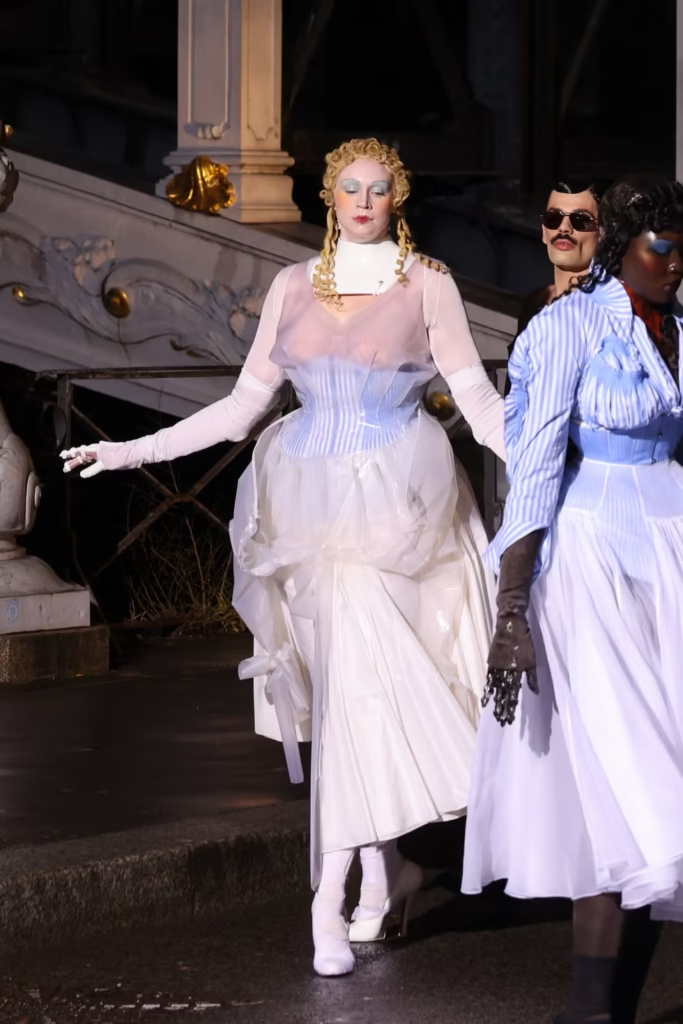
- Maison Margiela (since October 2014) – creative director; first couture show in 2015, Mutiny perfume in 2018, high-profile Artisanal 2024 show at Pont Alexandre III; departure in December 2024
- Zara – partnership announced in March 2026, two-year collaboration, first collection in September 2026
Awards? British Designer of the Year (1987, 1994, 1995, 1997), CBE title (2001), RDI (2002), Legion of Honour (2009, revoked in 2012).
A career full of ups and downs. But the facts speak for themselves.
Galliano’s design language
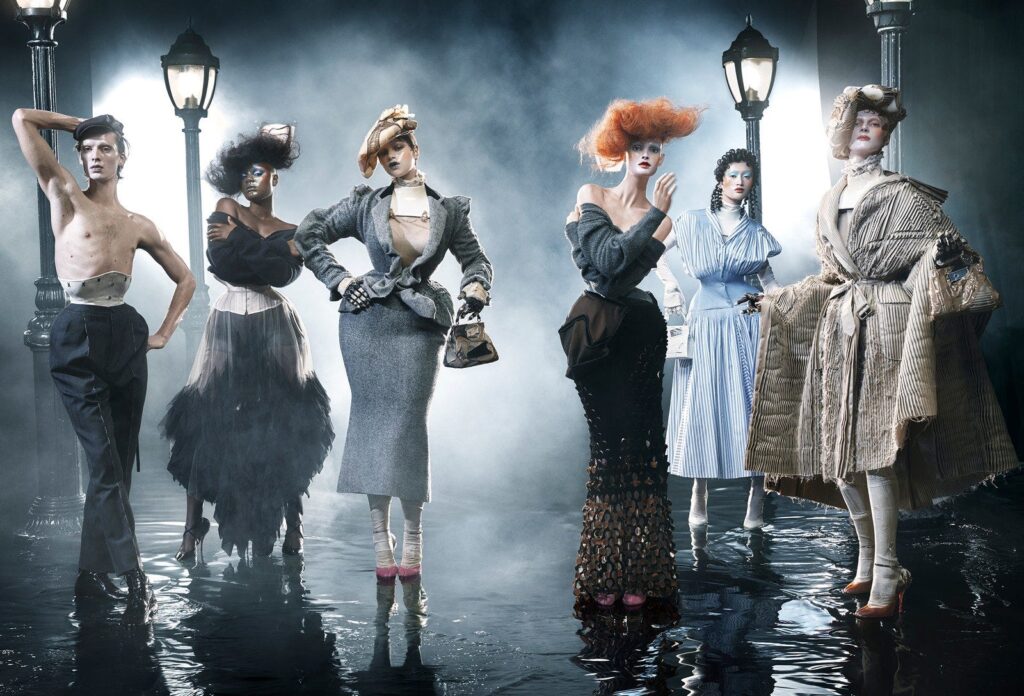
Galliano doesn’t design clothes, he builds narratives. His visual language is a theatrical tale, where every element of the costume carries layers of meaning drawn from history, literature, and art. Here we see a collage of eras and cultures: The French Revolution juxtaposed with the Victorian era, Belle Époque interwoven with Egyptian motifs, Japanese samurai, or Chinese chinoiserie. These are not quotations, but rather emotional echoes of the past.
The romance of history and the collage of cultures
Galliano draws from the past as if from a theatrical costume. His collections for Dior and Margiela are full of references to:
- France: Revolution, aristocracy, Belle Époque
- United Kingdom: Victorian era, Gothic romanticism
- Japan: kimonos, samurais, haori
- Egypt: hieroglyphs, pleating inspired by antiquity
- Germany: Weimar, cabaret, decadence
Everything blends into a single vision that is more a dream of history than its reconstruction. Sometimes even excessively so, but that’s exactly the point.
Techniques: draping, bias cut, and craftsmanship details
Here you can see his true craftsmanship. The bias cut is the foundation, a technique that allows the fabric to flow over the body like a liquid sculpture. Draping creates sensual asymmetry, while the details complete the whole:
- Waist-cinching corsets
- Lingerie neckline (bare shoulders, slip dress)
- Ruffles and layered skirts
- Embroidery crafted by hand over weeks
Each dress represents hours of work by petites mains, masters of haute couture tailoring.
From Spectacle to Deconstruction at Margiela
Galliano’s shows? Immersive performances. Scenography like in an opera, choreography, lighting, makeup ( Pat McGrath!), everything plays a role. It’s not just a presentation of clothes, it’s a total experience.
At Maison Margiela, he added deconstructive elegance: breaking down classic elements, reconfiguring them, recycling fragments from older collections. But the romanticism remains. An example? The viral Artisanal 2024 collection with McGrath makeup, which exploded in pop culture. Or the safety pin dress worn by Miley Cyrus at the 2024 Grammys.
Iconic items? The Dior Saddle bag (S/S 2000), still a cult favorite today. Without this spectacle and Galliano’s craftsmanship, he would have simply been a good designer. But he went further, creating his own language that speaks to the imagination.
The 2011 crisis and the path to redemption
February 2011. In the Parisian bar La Perle, a recording was revealed that definitively ended Galliano’s career at Dior. The incident had taken place a few months earlier, in December 2010, but it was only the publication of the video that sparked the uproar.
Note: offensive quote
“I love Hitler… People like you would be dead today. Your mothers, your forefathers, would all be fucking gassed and dead.”
Such words were spoken by the designer to random people. The consequences came quickly: suspension, and then dismissal from Dior in March 2011. In September of the same year, the court found him guilty of public insult on racial and ethnic grounds. The verdict: a suspended fine of €6,000.
Attempts at redemption and industry reactions
Galliano issued a public apology. He underwent addiction rehabilitation. The industry was divided—some supported him ( like Oscar de la Renta, who invited him to work in his studio in 2013), while others completely ostracized him. That job with de la Renta was the first sign that perhaps there was a path to return.
Debate on Responsibility
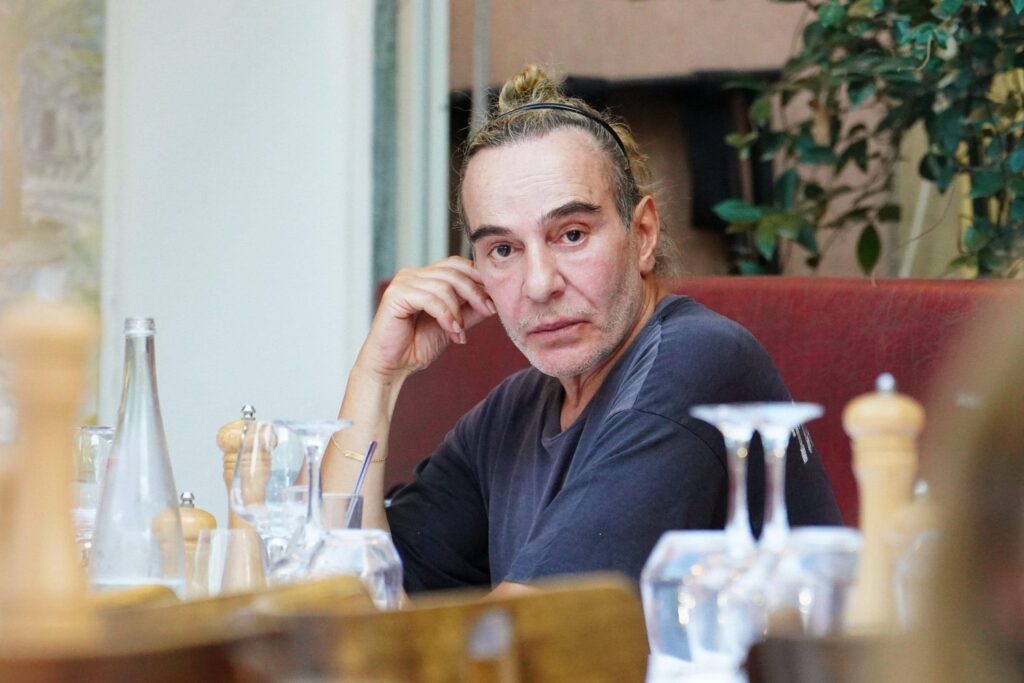
In 2024, Kevin Macdonald directed the documentary “High & Low, John Galliano,” which addresses precisely these most difficult issues. The pressure of the fashion industry, addiction to alcohol and medication, the boundaries of personal responsibility. The Anti-Defamation League (ADL) commented cautiously on the attempts at making amends, pointing out that redemption is possible, but it requires time and genuine action. The Galliano case remains a reference point in the discussion about whether talent justifies everything and where the line for a “second chance” should be drawn.
Impact and future
Galliano not only created beautiful things. He elevated Dior to a level that previously seemed unattainable. During his tenure, the brand was set to surpass $1 billion in sales, which, according to industry reports, was something extraordinary. Spectacular shows attracted a younger clientele, and icons like the Saddle bag went viral before the word even existed in its current sense.
At Maison Margiela, the effect was just as powerful, though different. Here we’re talking about double-digit sales growth, with revenues soaring from around €100 million to approximately €500 million (industry reports). Galliano took a deeply conceptual brand and made it commercially desirable without losing its identity.
Zara x Galliano: re-authoring the archives
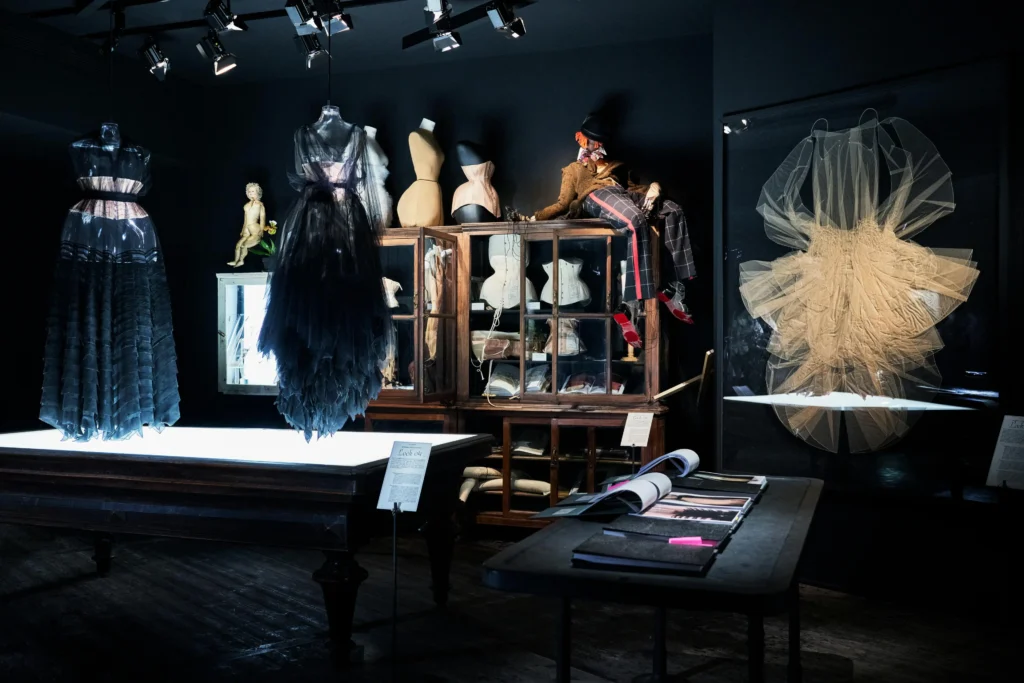
And now something completely new is coming. The partnership with Zara announced in March 2026, a two-year mandate for “re-authoring” the archives. It’s about deconstructing and reconfiguring past models into new collections. Galliano will work closely with Marta Ortega Pérez, with the first edition set to appear in September 2026.
Sounds like a bridge between luxury and the mass market, right? And that’s exactly the point. It could be about education on archives, about the long lifespan of projects (something like a sustainable mindset), though I won’t speculate beyond what we know.
What could this experiment change?
The question is whether this collaboration will change the way we think about the accessibility of a designer of this caliber. Galliano has always operated in the realm of haute couture, but now he is entering a space where millions of people actually buy clothes. If it works, we may see more similar partnerships. If not, at least it will be interesting.
What remains after fireworks?
The story of Galliano reminds us that fashion is not just about clothes, but about how far we can push the boundaries of imagination. His downfall was painful, but his legacy remains: he taught us that a show can be a total work of art, that history is a living material to work with, not a museum exhibit. It is from him that contemporary fashion learned to think theatrically.
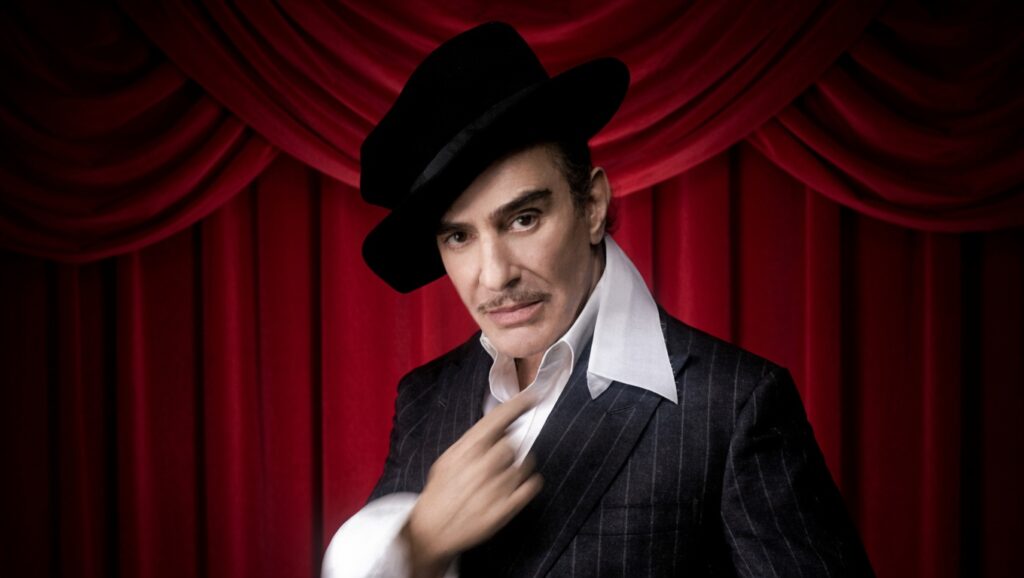
Today, we see his influence everywhere, though we rarely mention his name. Showmanship in fashion, the narrative quality of collections, the courage to draw from forgotten eras—all of this carries something of Galliano.
He became a visionary who changed the rules of the game. And even though he was out of the game for years, the rules he established are still in force today.
Lucky
High Class Fashion editorial team