
In the fashion world, a code has emerged that you can’t learn from guides. It’s called ” If You Know, You Know ” – you recognize quality, not the logo.
“If You Know, You Know.” This isn’t a marketing slogan, it’s a cultural code for millionaires who have stopped trying to prove anything.
Loro Piana became the king of this trend not by accident. In fact, the brand invented quiet luxury long before the “Succession” phenomenon turned a $3,000 sweater into a symbol of power. In 2024, we celebrate the brand’s centenary, which means anniversary exhibitions, limited collections, and even more attention from insiders.
Why now?
The trend gained momentum after the success of the series, but that’s only the visible effect of a deeper transformation. People are tired of noise. They want things that speak quietly, yet say everything: minimalism of design, timeless cuts, natural fibers, and craftsmanship executed so perfectly that you have to touch it to understand.
In this text, we will explore how Loro Piana builds this philosophy. From the principles of quiet luxury, through the legendary vicuña and baby cashmere, to the family heritage and control of the entire production chain, and finally the scale of presence and ethical questions that accompany such excellence. Let’s start with the basics.
Why Loro Piana is a symbol of quiet luxury and embodies the Piana principle
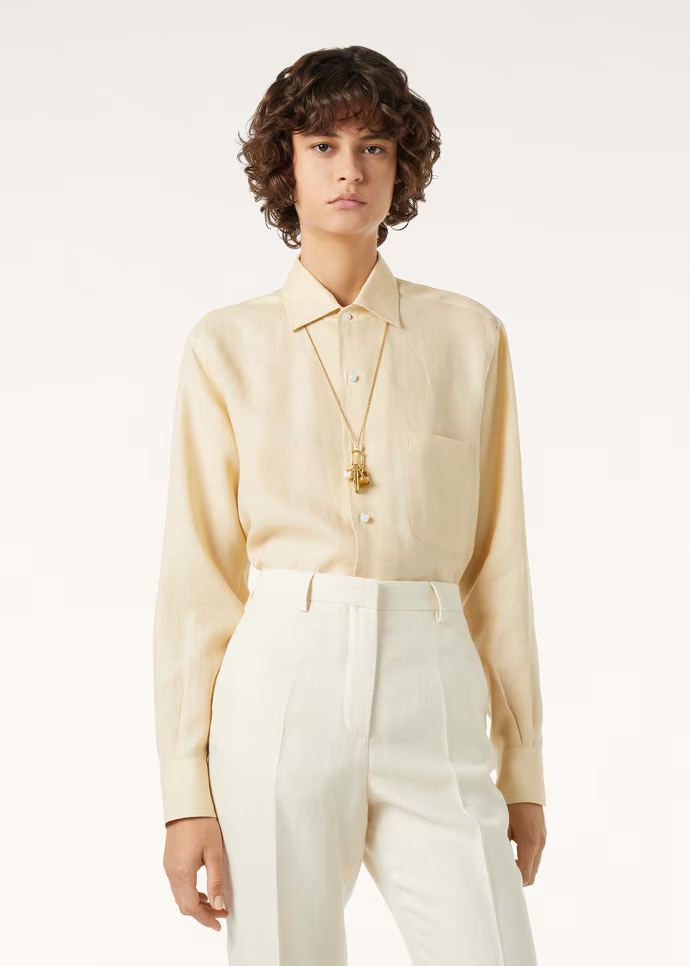
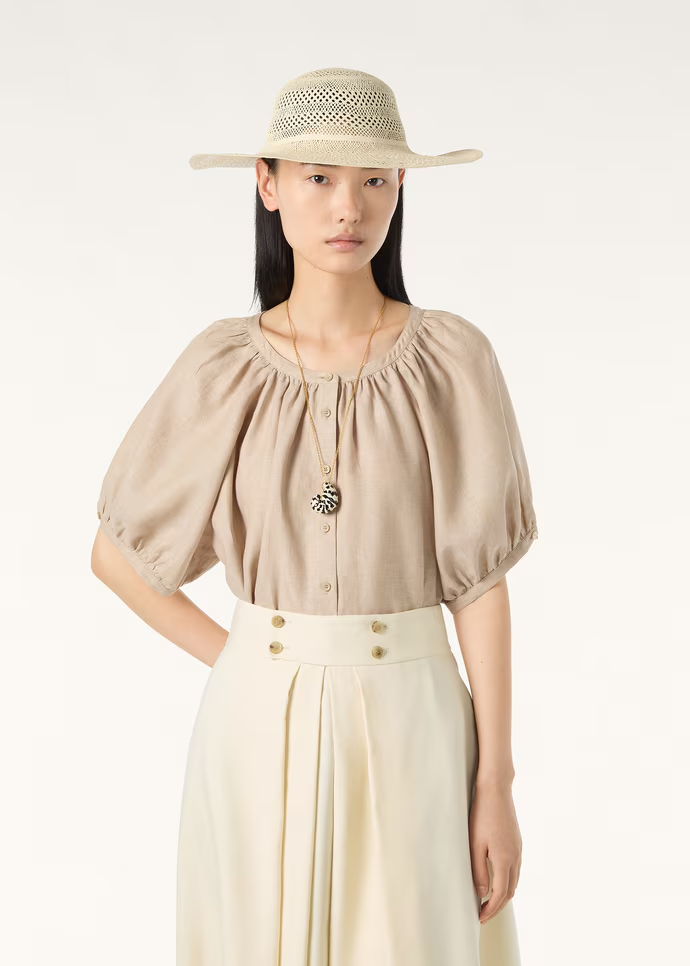
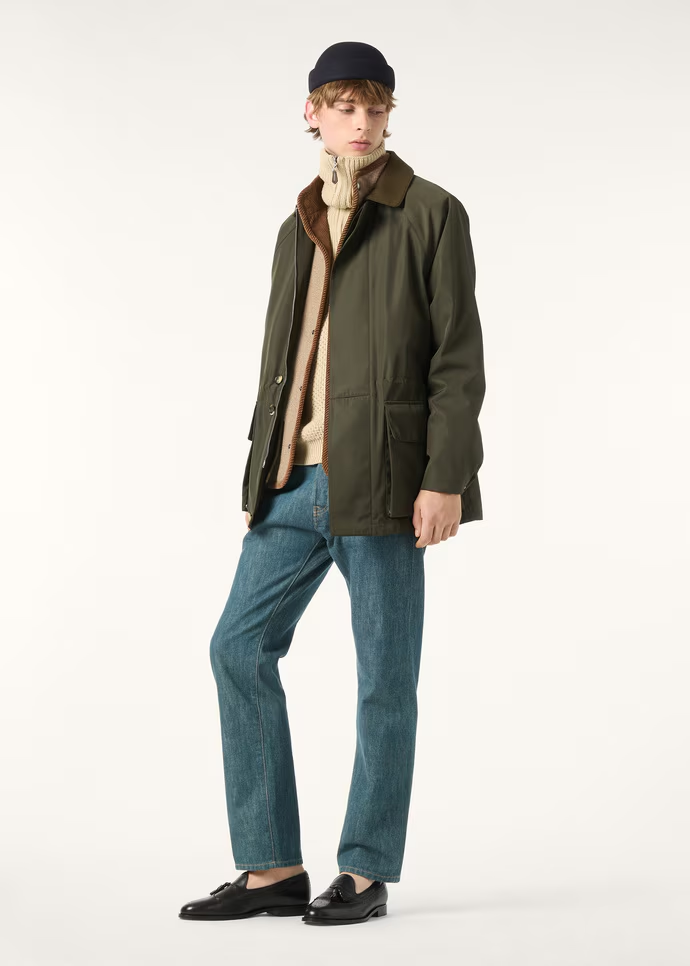
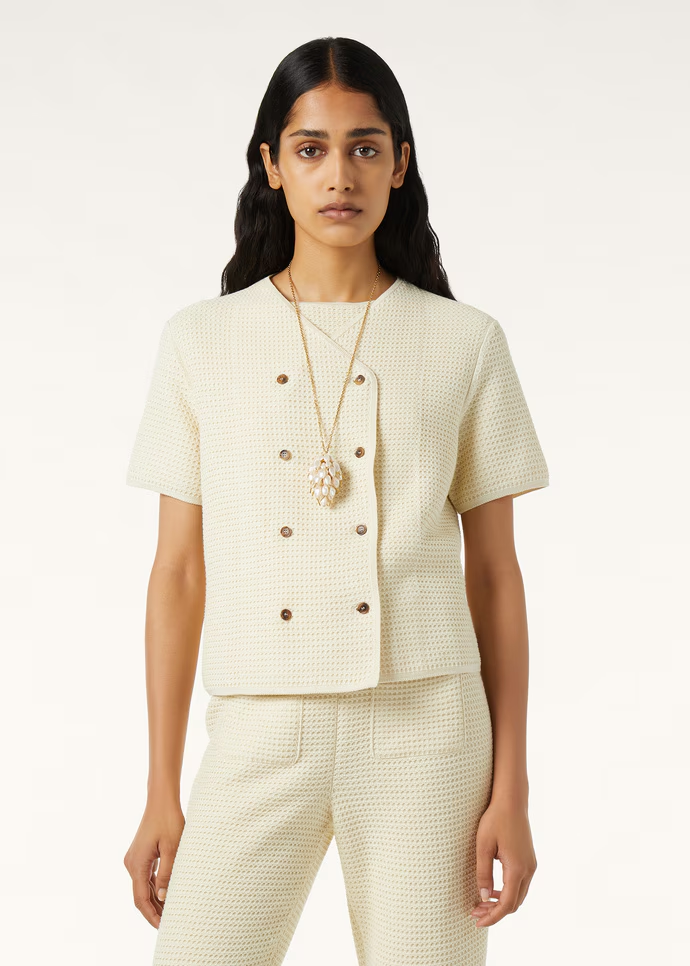
Quiet luxury is the essence of quality without shouting, wealth without a billboard on your chest. Their products don’t have big logos, and if they do, they’re microscopic. Their palette? Beiges, greys, navy, shades of nature. Simple silhouettes that look just as good today as they did ten years ago. This is exactly what Loro Piana does best: creating pieces that don’t age with the fashion seasons.
The contrast is obvious. Gucci or Louis Vuitton shout with monograms, Loro Piana whispers. Or maybe not even that, it simply is. You’ll recognize someone wearing a Loro baby cashmere sweater only if you know what to look for yourself. IYKYK, as they say nowadays.
The series “Succession” did more for the brand than advertising campaigns, showcasing this style in action. Suddenly, everyone wanted to look like Logan Roy in a beige turtleneck costing several thousand. It’s funny, because Loro Piana’s own management distanced themselves from the ” quiet luxury ” label, speaking instead of the ambition to be “the most desirable luxury brand,” period. No adjectives about quietness.
A signal recognizable only to insiders
Their aesthetics are based on several pillars:
- neutral colors (beige, camel, navy, gray)
- minimalist cuts resistant to trends
- zero ostentation (no visible logo)
- quality you can feel, not see
It’s a subtlety that requires expertise. And expertise requires materials. And this brings us to what truly lies behind these prices.
Rare fibers and technologies
Loro Piana’s quiet luxury is built on solid foundations: fibers that are extremely hard to source and technologies that protect them without compromising their character. Instead of a logo, you’ll more likely see a 12.5-micron parameter and a CITES certificate.
Vicuña
Vicuña, known as the “fiber of the gods,” is in fact the finest animal fiber in the world, measuring about 12.5 µm in diameter. It is legally sourced in the Andes, exclusively by shearing live animals protected by the international CITES convention. Since 2008, Loro Piana has managed the Franco Loro Piana reserve in Peru (2,000 ha), and since 2018, also the Water Project supporting local communities. Vicuña products? From $2,000 up to even $40,000. It’s not about the markup, but the rarity of the raw material.
Baby cashmere and Storm System®
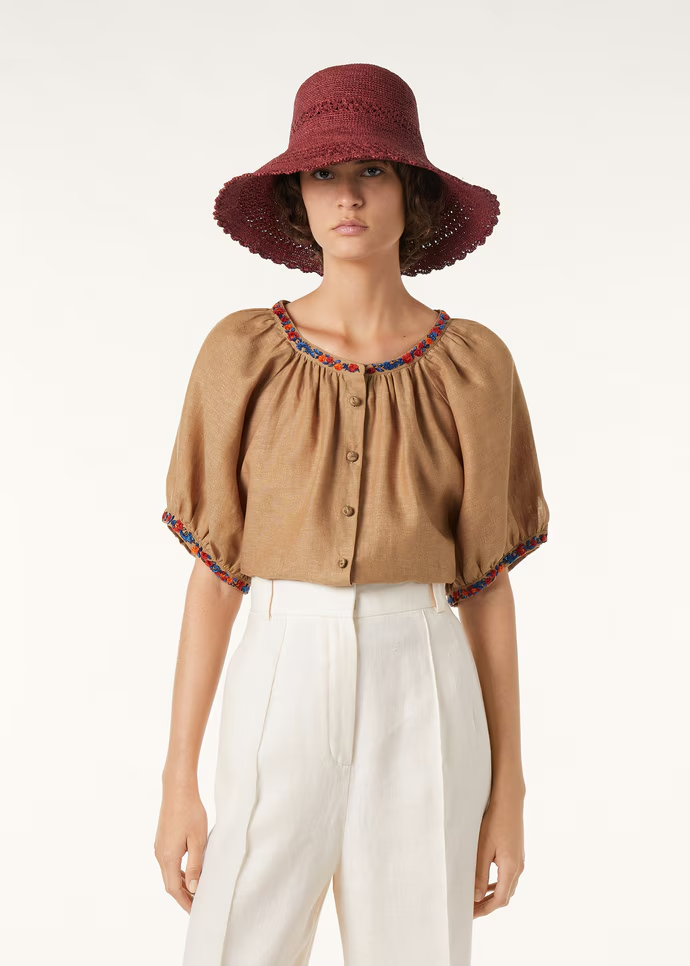
Baby cashmere comes from the undercoat of goats less than one year old, mainly from Mongolia and China. About 13.5 µm, averaging ~30 g from a single kid per year. The result? A softness that cannot be synthetically reproduced. Meanwhile, Storm System® is Loro Piana’s proprietary technology: a hydrophilic membrane and a special finish applied directly to cashmere or wool. Windproof and waterproof without sacrificing breathability. A cashmere jacket protects you from rain, yet you still feel the natural quality of the fiber.
| Fiber | Origin | Diameter (µm) | Key feature | Program/Specialization |
|---|---|---|---|---|
| Vicuña | Andy (Peru) | ~12.5 | the most delicate animal fiber | reserve 2,000 ha, Water Project |
| Baby cashmere | Mongolia, China | ~13.5 | softness, ~30 g/kid/year | direct sourcing |
| Cashmere/merino | Australia, Scotland | depending | premium types, without logo | Storm System® |
Most ready-to-wear is made in Italy. You can feel the quality by touch; you don’t need to see it.
From leotard to maison
A century-long history is truly a rarity in the world of luxury. Loro Piana had humble beginnings: the family traded wool in Piedmont as early as the beginning of the 19th century, but the company Ing. Loro Piana & C. was formally established only in 1924 in Quarona, a small town in Valsesia. At first, it was simply a textile company, not a fashion house.
From Quarona to the world
After the war, Franco Loro Piana pushed the business forward, but the real breakthrough came in the 1970s and 1980s, when Sergio and Pier Luigi Loro Piana focused on rare fibers (Tasmanian superfine, baby cashmere). In 1994, the brand did something almost impossible: it established a partnership with Peru and began working with vicuña, a fiber that had never before been used in commercial production. The first boutique was only opened in 1998 in Milan, and e-commerce was launched in 2012. Clearly, no one was in a hurry here.
Breakthrough? The year 2013, when LVMH bought about 80% for approximately 2 billion euros. The Loro Piana family retained a minority stake and some influence. In 2024, the brand celebrated its 100th anniversary with exhibitions in Milan, and in 2025 Frédéric Arnault became CEO (after Damien Bertrand), which shows how important LP is to the entire group.
Coat of arms and the identity of craftsmanship
The brand’s 1951 emblem is not just a decoration, but a manifesto. It features: a beech tree (the symbol of Quarona), an eagle, two stars, and teasels (a draper’s tool from the 16th century). This serves as a reminder that Loro Piana is, above all, Italian craftsmanship rooted in one place.
This vertical integration everyone is talking about? It’s the result of that long journey. Control from raw material to shoe wasn’t an overnight strategy, but a natural outcome of a hundred years of obsession with quality.
Scale, results, and elite distribution today
Let’s look at the numbers:
- around 180-182 boutiques worldwide (each carefully selected)
- from 4,000 to 5,100 employees
- about 10 production plants, mainly in the Valsesia region of Italy, plus one in Mongolia
- revenues 2024: approximately 1.609 billion euros
- net profit 2024: approximately 389 million euros
For comparison, in 2019 revenues reached around 720 million euros. There is a clear increase, although the brand deliberately does not pursue mass scale.
Distribution model without compromise
Loro Piana sells exclusively through its own boutiques and selective online sales. Zero wholesale. This is important because it means full control over where and how products reach customers, and the market is developing quite well—the estimated GMV for 2025 is around 92-117 million dollars, with a strong share of the US market.
Such a strategy comes at a price. It requires huge investments in retail and logistics, but it protects exclusivity. You won’t find Loro Piana in multibrand department stores or on discount platforms. Either you buy on their terms, or not at all.
Interestingly, this exclusivity also raises questions about supply chain transparency and the ethics of sourcing raw materials.
Shadow beneath the cashmere
As it turns out, even the most exclusive fibers have their controversies. A 2024 Bloomberg report shed light on Loro Piana’s relationship with communities in Peru’s Lucanas region, where vicuña is sourced. Journalists calculated that local herders receive about $280 per kilogram of fiber, while finished sweaters can cost up to $9,000. The difference? Quite significant. The company quickly responded, questioning the report’s methodology and emphasizing its longstanding support programs for the communities, ranging from education to infrastructure. Moreover, the Lucanas region supplies only about 4% of the total vicuña stock, which is less than media reports had suggested.
Subcontractors and “Made in Italy” risks
A more tangible problem emerged in Italy at the beginning of 2025. The court imposed judicial administration for about a year after serious negligence was discovered in the supervision of subcontractors. In workshops near Milan, workers were found employed in unacceptable conditions: 90-hour work weeks, rates below $5 per hour, and a lack of basic health and safety standards. Loro Piana immediately terminated cooperation with these subcontractors and fully cooperated with the authorities. The result? The extraordinary measure was lifted even before the deadline, following the implementation of improvements in the control system.
The whole story shows how complex the supply chain is, even with the legend of “Made in Italy.” For a brand that sells quiet luxury based on quality and authenticity, transparency becomes almost as important as the craftsmanship itself.
Silence that speaks the most
Loro Piana proves something that brands shouting their logos from every piece of fabric tend to forget. True luxury doesn’t need advertising, because it’s recognized by those who truly know. It’s a kind of understanding between people who value quality more than spectacle.
In a world where most people try to stand out, quiet luxury does exactly the opposite. It steps back, falls silent, and embraces subtlety. And that’s precisely why it works. Because, after all, true confidence doesn’t need the crowd’s approval.
Loro Piana is not just clothing. It’s a way of thinking about what luxury truly is.
Minn Y
editorial team
High Class Fashion